
Most people plant garlic in October, wait out the winter, and assume the payoff is one head pulled in July. Hardneck garlic hands you something to eat months before that, and a lot of gardeners walk right past it because nobody ever told them what they were looking at.
Garlic scapes are the curling flower stalks that hardneck garlic pushes up in early summer. You cut them off, you eat them, and the plant sends that energy back down into the head instead of up into a flower. That is why we call it the second harvest, and it arrives weeks before anything comes out of the ground.
What are garlic scapes?
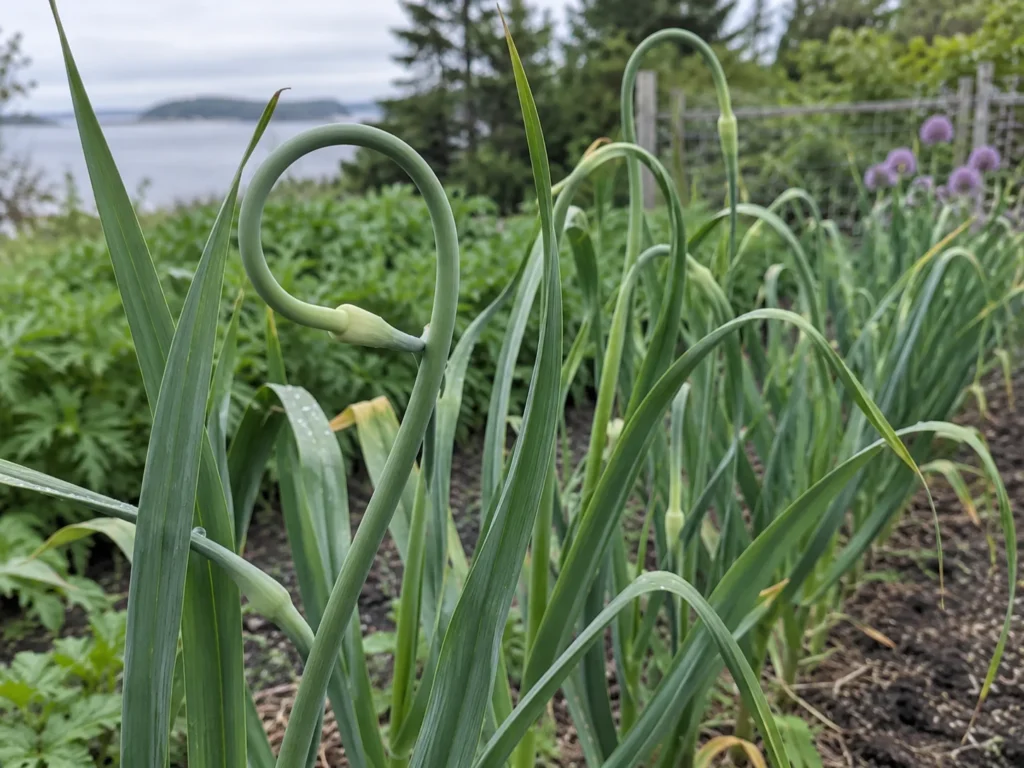
Garlic scapes are the seed stalks of hardneck garlic. Each plant sends up one round green stem from the centre of the leaves in early summer. The stem loops over into a curl and carries a pointed sheath at the tip that would open into a small cluster of bulbils if you left it alone.
Garlic scapes are not a sign that something has gone wrong. A scape is the plant doing exactly what hardneck garlic has always done. The word hardneck comes from that stalk, which stiffens into a woody core through the middle of the head if it is left in place all season.
Why only hardneck garlic gives you scapes
Softneck garlic, the braiding kind you see hanging in kitchens, almost never gives you garlic scapes. That is the practical difference between the two families, and it is the reason we order hardnecks for this coast rather than the braiding types.
Softnecks store longer and plait beautifully. Hardnecks give you bigger cloves, a stronger flavour, better cold tolerance through a Canadian winter, and one extra crop in June. If you want the full comparison, we wrote it up in hardneck and softneck garlic side by side for Canadian gardens.
A softneck under stress will occasionally push up a half hearted stalk, so if you see one on a braiding variety, that is the exception rather than a sign you bought something else.
What cutting the scape does underground
Once a garlic plant starts building garlic scapes, it spends carbohydrate on those flowers instead of on the bulb. Cutting the scape closes that door. The plant has nowhere else to put the sugar it is making, so it goes down into the bulb through the last few weeks of sizing up.
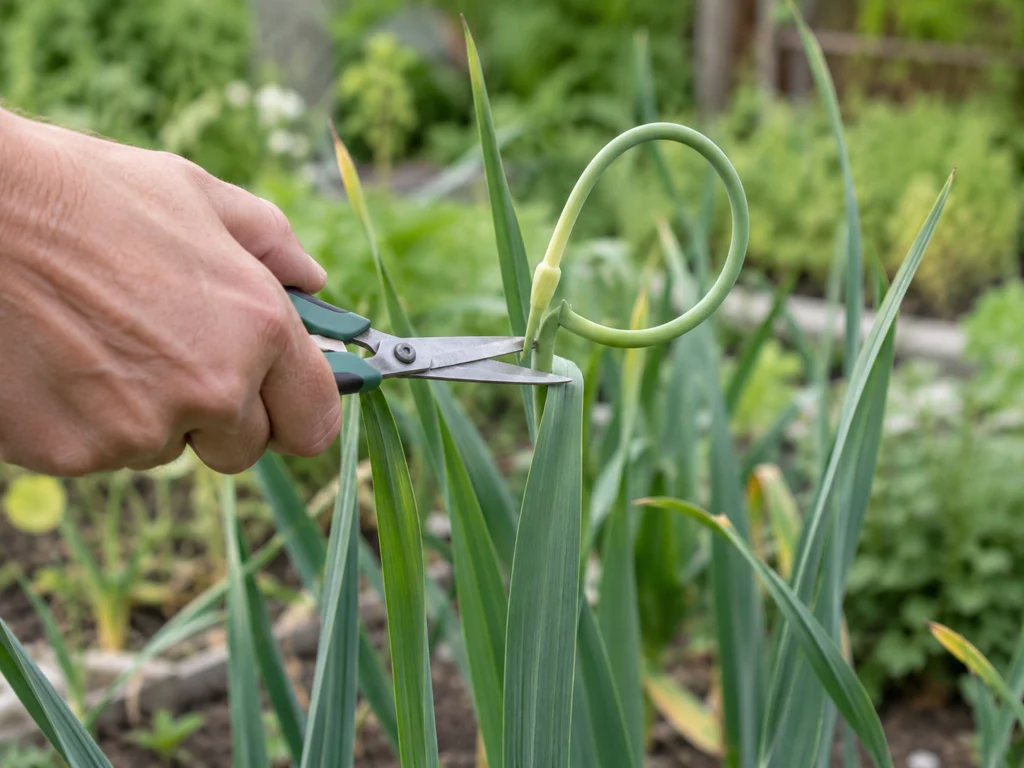
Growers who cut scapes generally pull larger heads than growers who leave them, and the difference is easy to see when you lay two beds side by side. We would rather tell you what we have seen in July than quote you a percentage off a study done somewhere with a very different summer.
There is a second reason to cut garlic scapes. A dry, hollow stalk left standing is an open pipe into the top of the bulb during a wet Vancouver June. Take it off and that pipe never exists.
When do garlic scapes appear in Canada?
On the coast, scapes usually show up in the first half of June, roughly three to four weeks before the heads are ready. On the prairies and in eastern Canada they run later, often the last week of June into early July. Your own bed tells you more than the calendar does.
Watch the centre of each plant rather than the whole bed. The stalks do not come all at once, and you will be walking out with snips two or three times over about ten days. The exact moment to cut deserves its own explanation, and it is the whole subject of our guide to when to cut garlic scapes.
What garlic scapes taste like and how to cook them
Garlic scapes taste like mild garlic with the texture of a green bean. Nothing about them is sharp or hot the way a raw clove is. Cut into short lengths, hot pan, butter, five or six minutes until they turn a deeper green and soften at the bite.
Beyond that, four things we make every June.
- Scape pesto. Blitz the scapes with olive oil, hard cheese, a handful of nuts, and lemon. It freezes well in an ice cube tray.
- Grilled whole. Toss in oil, lay them across the grill, turn once, finish with salt.
- Chopped into scrambled eggs or a potato salad, raw, in small amounts.
- Scape butter. Fine chop, work into softened butter, roll in paper, freeze. It goes on steak and on bread.
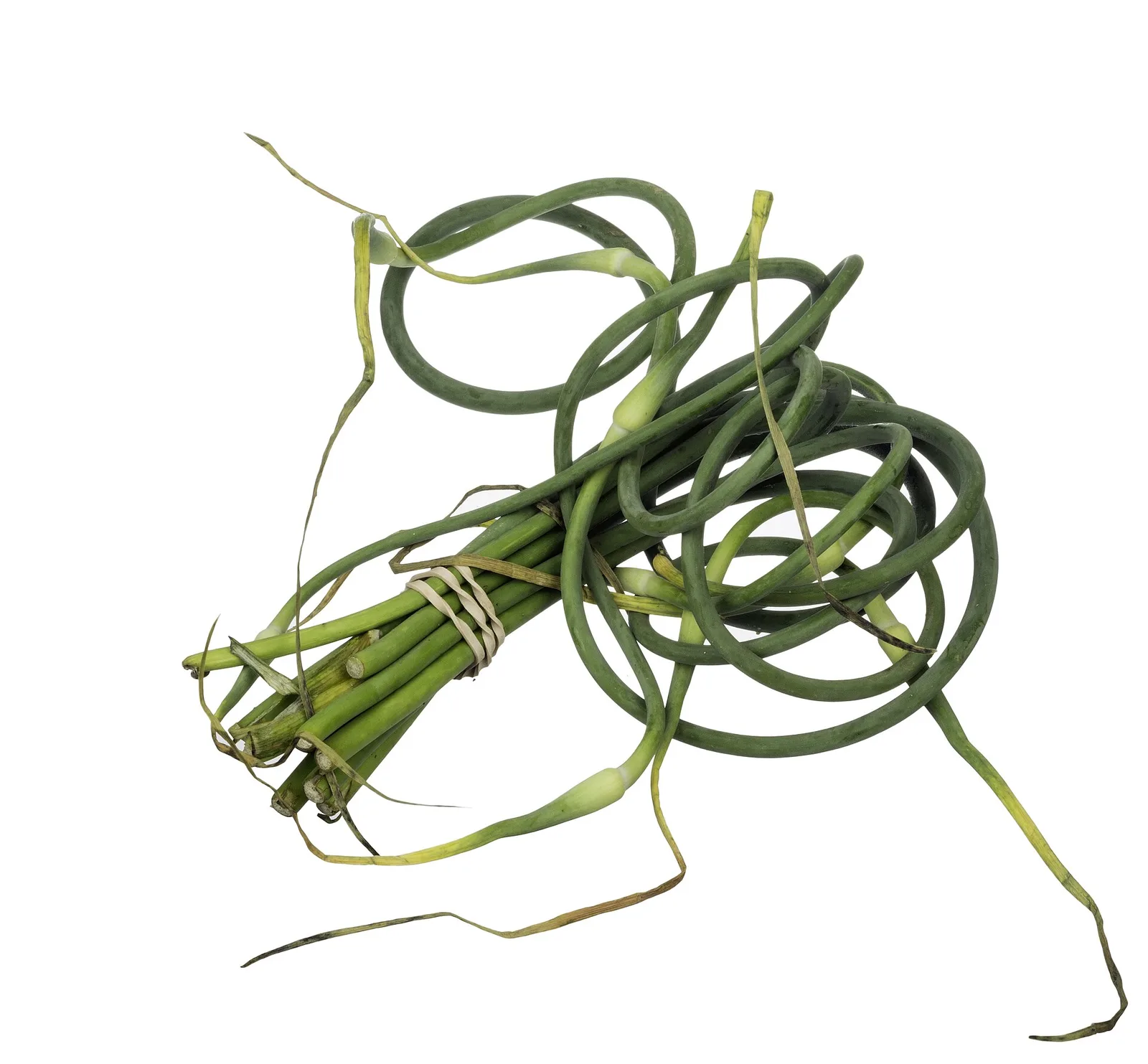
Cut off the pointed tip and the last stiff few centimetres near the top if it feels woody. Everything below that is tender. Fresh scapes hold in the fridge in a loose bag for two or three weeks, and chopped scapes freeze fine for cooking later, which is the one time a freezer and garlic are on good terms.
What happens if you leave the scape on
Garlic scapes left in place straighten, stand upright, and the sheath at the tip splits open to show a cluster of bulbils, which are tiny clove shaped seeds that look like miniature garlic. The head below stays smaller than it would have been.
Those bulbils are not useless. Plant them in the fall in a nursery row and they grow into a single undivided round the first year, then a small head the year after that. It is a slow way to build stock from a variety you like, and it is worth doing on purpose with one or two plants rather than by accident with the whole bed.
If you are growing garlic in pots on a balcony, leave the scapes even less time. A pot has less soil to draw on, so the head pays a bigger price for the flower. Our notes on growing garlic in containers cover the rest of that setup.
The scape starts with what you plant in October
You cannot decide in June to have garlic scapes. That was decided the previous autumn, in the bag you brought home, because the softneck heads at the supermarket will give you a fine crop of garlic and not one curl.
That is why every variety in the hardneck trio Darrell picked for this coast is a scape maker. Three varieties, planted the same October week, come up on slightly different schedules, so the June cutting stretches out instead of landing all in one afternoon.
Ordering seed garlic for next June
Picture the first week of June next year. You walk out before work with a pair of snips, come back with a fistful of green curls, and dinner is decided. Nine or ten months earlier, all you did was push some cloves into a bed on an October afternoon.
Seed garlic comes to us in small lots, and once a variety is spoken for it is gone until the following autumn, because nobody reorders partway through a garlic season. The deadline on the other end is set by the ground rather than by us. Once the soil is cold and hard in late October and November, the planting window closes on its own.
Ordering ahead is simply the difference between planting the varieties you had in mind and planting whatever is still on the table in October, on better terms than waiting for them to reach the shelf. If you want a look at the hardneck varieties we set aside for fall planting, they are all in one place.
If you would rather watch than read, Darrell covers why Darrell gives garlic a bed of its own every year in a short video on our channel.
Why garlic scapes are worth planning a year ahead
You cannot buy your way into this one in June. Garlic scapes almost never reach a shop because they bruise and do not travel, so the only reliable supply is a bed you planted the previous October. Plant the wrong type and the June harvest simply does not exist, and you find out when the beds around you are curling and yours are not.
The money in it is small but real. A hardneck bed hands you two crops off one planting, and the June one lands in the weeks when nothing else in a Canadian garden is ready to eat. Plant softneck by accident and you paid for a full season of bed space and got one crop out of it.
The part that grinds is the reading. Fall planting advice contradicts itself constantly, and much of what you find about garlic is written for climates that never freeze. You end up standing over a shelf of packets with no way to tell which one curls in June and which one does nothing.
So we do the sorting here. Every variety we bring in is a scape maker, the boxes are opened on our own bench rather than shipped blind from a warehouse, and each seed bulb is felt at the shoulders before it is packed. Reserving before the packs reach the shelf holds better terms than waiting. Darrell has more than 25 years of hands on gardening and landscaping behind him and cuts these beds himself every June.
Get it right and in most years the first week of June is a fistful of green curls before work, dinner decided, and neighbours asking what they are. Get the type wrong and garlic scapes stay a thing you read about once and never ate.
Frequently asked questions
Can you eat garlic scapes raw?
Yes. Raw scapes are milder than a raw clove, closer to a green onion with a garlic edge, and they are good chopped fine into salads, dips, and potato salad. Use less than you think at first. The tip near the sheath can be fibrous, so trim that off and keep the tender green length below it.
Do garlic scapes mean my garlic is ready to harvest?
No, but they are a useful signal. The scapes usually appear about three to four weeks before the heads are ready to lift. After you cut them, keep watching the leaves. When the lower three or four leaves have browned off and the upper ones are still green, it is time to start checking a bulb.
Why does my garlic not produce scapes?
Almost always because it is a softneck variety, which rarely sends up a stalk. Supermarket garlic in Canada is usually softneck, so a bed grown from a grocery head often gives no scapes at all. Hardneck varieties bred for cold winters are the ones that curl reliably every June.
How long do fresh garlic scapes keep?
Loose in a bag in the fridge, two to three weeks, and they stay usable longer than that even as they soften. For anything past a month, chop them and freeze them, or turn them into pesto or scape butter and freeze that. Frozen scapes lose some snap but keep their flavour for cooking.
Come and see us in Kitsilano
DH Garden Centre
3742 West 10th Avenue, Vancouver, BC V6R 2G4
Open daily, 11:00 to 18:30
604-929-7335
If you are anywhere near Kitsilano, come in and ask Darrell which of the hardnecks he would put in your bed. He has been growing garlic on this coast for more than twenty five years and he opens the boxes himself when they land.
Keep reading


Have a plant question? Bring it to the counter.
DH Garden Centre is at 3742 West 10th Avenue in Kitsilano, Vancouver, open 11:00 to 6:30 every day. Bring the plant, or a photo of the spot you want to fill, and we will look at it with you. If you buy a pot here we repot the plant at the counter, soil included up to 5 litres.
