
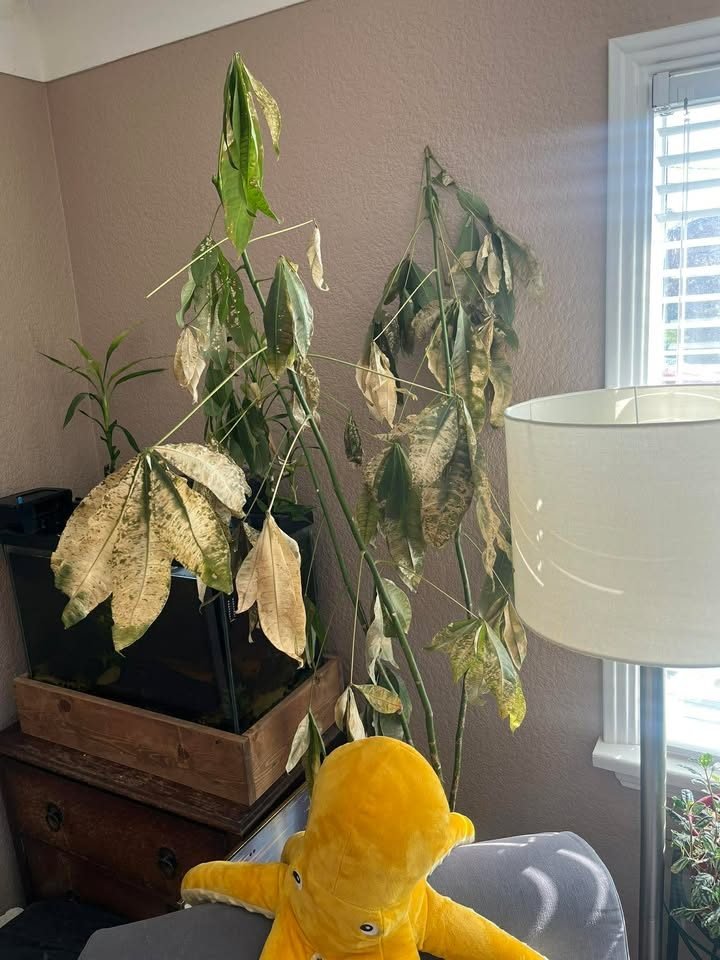
The message came in with a photo and one line: “I hope I can salvage her!”
The plant was a money tree that had spent time in a garage before coming home to its new owner. By the time it arrived, most of the leaves were pale, spotted, or crispy, and the soil was soaking wet. She had already moved it to a gentler spot and was standing there wondering what to do next, which is exactly the right question to ask before touching anything.
If you are looking at an overwatered money tree right now, this is the same step by step we sent her.
Can an overwatered money tree be saved?
Usually, yes. A money tree with soggy soil and heavy leaf loss can recover if its roots have not fully rotted. The rescue has four steps: stop watering until the soil dries out, remove the leaves that are already dead, confirm the stems are still alive with a scratch test, then give it bright indirect light and several undisturbed weeks.
Money trees, Pachira aquatica if you want the label on the tag, store water in that braided trunk. It buys you time that thinner plants do not get. We have seen trees in worse shape than this one come back to full, glossy leaves.
Step 1: Stop watering and check the soil
This is the step people skip, because a droopy plant looks thirsty. After overwatering, more water is the one thing that can actually finish the plant off.
Push a finger two to three inches down into the soil.
Still wet or cool and heavy: do not water. Let it dry, and check again every few days. Moving the pot somewhere with good air flow helps.
Dry at that depth: give one deep, slow watering until water runs out the bottom of the pot, then go back to waiting.
For this tree, the soil was still wet from before the handover, so her instruction was simple. Hands off the watering can.
Step 2: Remove the leaves that are already gone
Any leaf that is mostly brown, crispy, or heavily spotted is not coming back. Take it off.
This feels brutal when half the plant qualifies, and the tree will look bare afterwards. Do it anyway. Every dying leaf is still drawing on the plant’s limited energy, and after a stress like this, that energy needs to go into roots and new growth instead. A bare tree with living stems recovers faster than a full looking tree carrying dead weight.
Step 3: Do the scratch test
Before you trim any stems, find out what is actually alive. Scratch the surface of a stem lightly with your fingernail.
Green underneath: alive. Leave it. It can push out new leaves.
Brown and dry underneath: that section is finished. Trim it back a few inches at a time until the scratch shows green.
On a braided money tree, check each trunk separately. It is common for one trunk in the braid to give up while the others stay healthy, and one dead trunk does not doom the tree. We covered the scratch test in more detail in our story about a ficus dropping its leaves, where the same five minute check told the owner exactly what to keep.
Step 4: Light, then patience
Put the tree in bright, indirect light. Near a window is good. Long hours of hot direct sun on damaged leaves is not. Then comes the hard part: leave it alone for two to four weeks.
No fertilizer yet. Feeding a stressed root system pushes growth it cannot support.
No moving it around. Every new location is one more change to adapt to.
Just steady light, and water only when the top layer of soil is dry. If the roots are sound, you will see small new leaves at the top or along the nodes within a few weeks.
How long does a money tree take to recover?
Expect the first signs of new growth in two to four weeks, and a presentable plant in two to three months. Recovery speed depends on how much root damage happened before the rescue started. A money tree that gets steady light and disciplined watering recovers noticeably faster than one that keeps being fussed over.
The pot check that prevents the next emergency
Once your money tree is stable, look at what it is planted in. Overwatering is rarely just a habit problem. It is usually a drainage problem wearing a disguise.
If the pot has no drainage hole, or the nursery pot sits inside a decorative cover where water collects, the soil stays wet no matter how careful you are. A ceramic pot with a real drainage hole and a saucer, about two inches wider than the root ball, removes most of the guesswork. We make a point of stocking handmade ones with proper drainage at the shop, and they are all on our Vancouver pottery page.
Update on this tree
This rescue is still in progress. The owner is following the steps above, and we will update this post with photos as the tree responds. Recovery is not instant, and we would rather show you the honest timeline than a miracle.
FAQ
Are yellow leaves on a money tree always from overwatering?
Not always, but it is the most common cause, especially when yellowing starts on lower leaves and the soil feels wet. Yellow leaves with dry, light soil point to underwatering instead. Check the soil before you change anything.
Should I repot an overwatered money tree right away?
Only if the soil refuses to dry within a week or the pot has no drainage. In that case, repot gently into barely damp, fresh soil and a draining pot. If the soil is drying on its own, wait. Repotting is its own stress.
The trunk feels soft near the soil. Is it too late?
A soft, mushy trunk base means rot has reached the trunk, and that section will not recover. On a braided tree, remove the soft trunk and give the healthy ones the best conditions you can. If every trunk is soft, the tree is telling you the answer.
Should I cut back to the trunk knobs or just remove dead leaves?
Start with the dead leaves only. Then scratch test the stems. Trim each stem back only as far as the dead, brown section goes. Cutting healthy green stems back to the knobs removes growth points the tree could have used.
Keep the rescue checklist on hand
Every plant in this story got into trouble through watering guesswork, and that is fixable. The exact checklist we use at the shop, written for Vancouver homes, is in our free guide: The Vancouver Plant Care & Repotting Guide. Download it before the next plant needs it.
Or skip the guesswork entirely: bring your plant, or a photo of it, to the shop. A quick look usually tells us whether it can come back and what to do first.
DH Garden Centre
3742 W 10th Ave, Vancouver, BC V6R 2G4 · (604) 929-7335
Open 7 days, 11:00 a.m. to 6:30 p.m., often later
Find us on Google Maps
Keep reading

Have a plant question? Bring it to the counter.
DH Garden Centre is at 3742 West 10th Avenue in Kitsilano, Vancouver, open 11:00 to 6:30 every day. Bring the plant, or a photo of the spot you want to fill, and we will look at it with you. If you buy a pot here we repot the plant at the counter, soil included up to 5 litres.
