

Every June somebody stands over a garlic bed holding a pair of snips, looking at a green curl, and wondering when to cut garlic scapes. Cut too soon and you take leaf area the plant was still using. Leave it too long and the head underneath stops growing.
The short answer on when to cut garlic scapes is one full curl. Wait until the stalk has looped around itself once, and cut it before it straightens back up and the pointed tip starts to swell. On the coast that usually falls in the first half of June, and later in the month across the prairies and eastern Canada.
When to cut garlic scapes: the one full curl rule
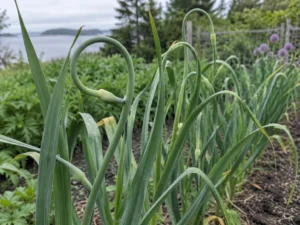
When to cut garlic scapes is written in the stalk, which comes up straight, bends over, and makes a loop. That single complete loop is your signal. At that stage the stalk is tender the whole way down, the flavour is at its mildest, and the plant has not yet spent much on building bulbils at the tip.
Growers who know when to cut garlic scapes wait for that first curl rather than snipping the moment a stalk appears, and the reason is simple. A very young scape is still a small green stalk doing a little photosynthesis, and taking it does nothing extra for the bulb. Waiting for the curl costs you nothing and gives you a longer, better eating scape.
How do you know a garlic scape is ready to cut?
To judge when to cut garlic scapes, look for three things at once. The stalk has made one complete loop, the tip has not yet pointed back up at the sky, and the pointed sheath at the end is still slim rather than fattening. If you run the stalk between two fingers it should feel springy, not woody, from top to bottom.
The clearest signal for when to cut garlic scapes is direction. A ready scape is still travelling sideways or downward in its curl. Once the tip lifts and aims upward again, the plant has decided to flower and you are past the ideal window.

What happens if you cut the scape too early?
Not much harm, honestly. You lose a little green tissue and you get a shorter, thinner scape for the kitchen. The bulb below will still size up normally. If you are unsure when to cut garlic scapes, err on the early side, because a week early is a much smaller mistake than three weeks late.
The one thing worth avoiding is cutting into the leaves while you are in there. Leaves are the engine that fills the head. Each leaf on a garlic plant corresponds to a wrapper layer around the bulb, so damaging them costs you more than an early scape ever will.
What happens if you leave it too long
The curl straightens, the tip swells, and the sheath eventually splits open to show a cluster of bulbils. All of that costs the head. The plant is finishing a flower instead of finishing your garlic, and you feel it as a size difference at harvest.
A late scape is still edible. It is just tougher, and you end up trimming the top third away. If your garlic is already at this stage this year, cut them anyway. The plant stops spending on the flower the moment you take it off, and there are usually still two or three weeks of bulb sizing left.
There is a second reason not to wait. In a wet Vancouver June, a woody hollow stalk standing over the bulb is a channel for water and rot down into the neck. Taking the scape off removes that.
Where exactly to cut on the stalk
The place matters as much as the moment, so when to cut garlic scapes settled, take it just above the top leaf, where the round stalk clears the last flat leaf blade. Use clean snips or a sharp knife and take it in one pass.
Do not reach down into the neck of the plant to get a longer piece. A cut low on the stem is a wet wound sitting directly over the bulb, and in a rainy June that is where soft rot starts. The short stub you leave behind dries off on its own within a few days and closes over.

Cut in the morning if you can, when the stalks are firm with water. They snap cleanly and they go into the kitchen crisp.
Do you cut them all on the same day?
No. In a bed of one variety the scapes will come over about a week to ten days, and if you are growing three varieties they will be staggered further than that. Deciding when to cut garlic scapes is a plant by plant judgement, not a date you mark once for the whole bed. Walk the rows every two or three days with snips in your pocket, and the plants will tell you when to cut garlic scapes better than a calendar will.
That staggering is a good argument for planting more than one hardneck variety, because it spreads both the scape cutting and the July harvest instead of dumping everything into one weekend. It is part of why we put three different hardneck varieties in one pack rather than nine bulbs of the same thing.
What if your garlic never sends up a scape
Then when to cut garlic scapes is not your question at all, because you are almost certainly growing softneck garlic, which rarely produces a stalk. There is nothing to cut and nothing to fix, and the heads will still form normally. It just means no June harvest. The background on which family does what is in our piece on what garlic scapes are and why hardnecks make them.
Timing at the other end of the season matters too. Scapes usually appear three to four weeks before the heads are ready to lift, and the planting depth you chose the previous October shows up in how strongly the plant pushes that stalk. If you are still deciding how deep to go, we covered that in how deep to plant garlic in Canada, and pots have their own rules in growing garlic in containers.
Next June starts with this October
Here is the picture. First week of June, before breakfast, you walk out with snips and come back with a handful of green curls for the pan. The whole cost of that was one October afternoon with a trowel. Knowing when to cut garlic scapes only pays off if there is a hardneck in the ground to cut, and that decision belongs to this autumn.
The seed garlic that makes it happen arrives with us in small lots, and once a variety is spoken for it is gone until the following autumn, because nobody reorders partway through a garlic season. The real deadline is not ours either. It belongs to the ground, which turns cold and hard through late October and November and closes the planting window on its own schedule.
The hardneck varieties Darrell set aside for fall planting are all in one place if you want a look.
If you would rather watch than read, Darrell covers what else a garlic plant gives you besides the head in a short video on our channel.
What knowing when to cut garlic scapes is actually worth
This is a small job with an outsized bill attached. Miss the window and the plant finishes a flower instead of finishing your garlic, so the head you lift in July is smaller than the one you would have had. Same bed, same nine months, same weeding. You handed a share of the crop to a flower nobody wanted.
There is a second charge in a wet June. A woody hollow stalk standing over a bulb is an open pipe into the neck of the plant, and soft rot goes down it. Losing heads that way in the last three weeks, after surviving a whole winter, is what puts people off growing garlic altogether.
The stressful part is that nobody can give you a date. Search for it and you get calendars for climates unlike yours, so you stand over the bed with snips, cut nothing, and come back the next day to do the same. Three days of that is more tiring than the cutting.
What we can do sits back in October. Every variety we bring in is a hardneck that curls reliably, the boxes are opened here rather than shipped blind, and each seed bulb is pressed at the shoulders before it goes in a pack. Darrell has more than 25 years of hands on gardening and landscaping behind him and walks his own rows with snips every June.
Judge when to cut garlic scapes properly and you get supper in June and a heavier head in July from the same plant. Leave it three weeks and you can lose a noticeable share of a crop you already paid a winter for.
Frequently asked questions
Does cutting garlic scapes really make bigger bulbs?
Yes, and it is one of the few garden jobs where the payoff is easy to see. Once the flower stalk is gone the plant has nowhere to put its energy except the head, during the last few weeks when the bulb is sizing up. Lay a cut row beside an uncut row at harvest and the difference is obvious.
Can I cut garlic scapes in the rain?
You can, but wait for a dry stretch if one is coming. A fresh cut on a wet plant in a cool June is the sort of small opening that fungal rot likes. A dry morning, clean snips, and a cut above the top leaf together make that risk very small.
What if I already missed the window this year?
Cut them now anyway. Even a straightened scape with a swelling tip is worth removing, because the plant redirects to the bulb as soon as it is gone. You will lose some size compared with cutting at the curl, but far less than you lose by letting it flower all the way out.
Should I cut scapes on garlic grown in pots?
Yes, and sooner rather than later. A container holds a limited volume of soil and nutrients, so the head has less to draw on and pays a heavier price for building a flower. Cut at the first full curl and water steadily through the last few weeks of sizing up.
Come and see us in Kitsilano
DH Garden Centre
3742 West 10th Avenue, Vancouver, BC V6R 2G4
Open daily, 11:00 to 18:30
604-929-7335
Bring a photo of your bed in June and we will tell you whether to cut this week or next. Darrell is usually in the shop on West 10th, a few blocks up from the middle of Kitsilano, and he has been reading garlic beds on this coast for more than twenty five years.
Keep reading
Have a plant question? Bring it to the counter.
DH Garden Centre is at 3742 West 10th Avenue in Kitsilano, Vancouver, open 11:00 to 6:30 every day. Bring the plant, or a photo of the spot you want to fill, and we will look at it with you. If you buy a pot here we repot the plant at the counter, soil included up to 5 litres.
