
The hole in the bottom of a pot decides whether roots sit in water or not. Get that one thing right, and the plant is far easier to keep alive through a wet Vancouver winter.
This is how to choose a pot for your plant, the same way we do it at our counter in Kitsilano. We look at three things. The hole, the material, and the spot where the pot is going to stand. The rest is taste, and taste is yours.
None of it takes long. Once you know what to look at, you can choose a pot for your plant in one pass down an aisle.
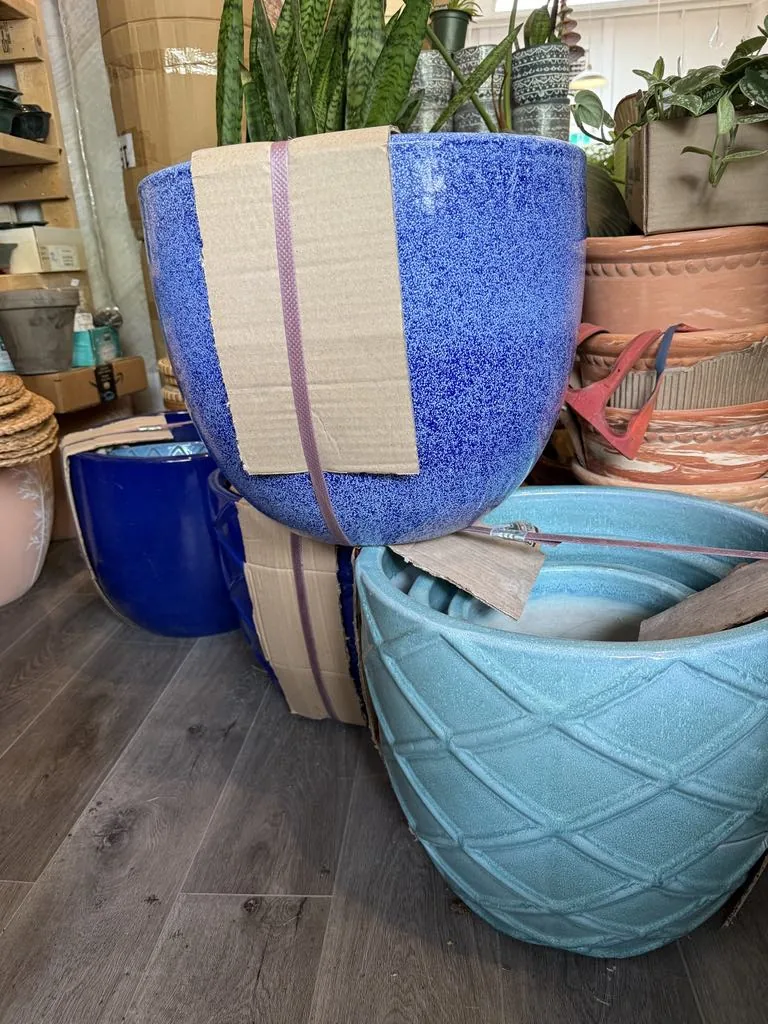
Three questions we ask before you choose a pot for your plant
People walk in holding a plant and pointing at a shelf. We slow that down with three questions.
Does this plant root deep or root wide? Some plants send roots straight down. Others spread out near the top of the soil. A tall pot suits the first kind, and a low wide bowl suits the second. If you are not sure, tip the plant out and have a look. The shape of the root ball tells you more than the label does.
Will the pot stand indoors, or outside in the rain? Indoors you control the water. Outside, the rain waters for you for months, and it does not stop when the soil is already full. An outdoor pot needs a real hole and it needs to sit up off the ground. We go into that in can ceramic pots stay outside in a Vancouver winter.
How do you water? Be honest with this one. Some people give a little water every few days. Some give a lot, then forget for two weeks. The first kind does better with clay. The second kind does better with a glazed pot. Same plant, different pot.
Darrell Smith co-founded DH Garden Centre. He walks through the same three questions in this one.
Does every pot need a drainage hole?
Yes. The pot the plant lives in needs a hole. Water has to leave the root ball. With no hole, the soil at the bottom stays wet after every watering, and wet soil is where roots rot. A pot with no hole is still useful. It just should not be the pot the plant grows in.
What you notice first is the leaves. Soft brown leaves in a pot with no hole usually come down to the pot itself. The hole is the first thing to settle when you choose a pot for your plant. Look at the base before the glaze.
There is a short on why a growing pot needs a drainage hole.
What to look for in modern indoor plant pots with drainage holes
A pot with drainage holes in the base lets the water leave after every watering. Three things to check with your thumb before you buy.
- The hole is open all the way through, rather than a dimple left in the clay.
- The base sits flat, so a saucer under it does not rock.
- The hole is wide enough to put a fingertip through, rather than a pinhole in the glaze.
Ceramic, terracotta or plastic, which pot is right for a Vancouver home?
Glazed ceramic holds water the longest. Clay dries the fastest. Plastic sits in between and weighs almost nothing. Pick the pot that matches how you water. You can always hide plastic inside something nicer.
| Pot | What it does with water | Who it suits |
|---|---|---|
| Glazed ceramic | Keeps the soil damp longer | People who forget a watering |
| Clay, or terracotta | Breathes, dries out fast | People who water often, and cactus |
| Plastic | Light, holds water in | Big plants you move, nursery pots |
Material is the second thing to settle when you choose a pot for your plant. Clay is an honest material. The wall breathes, so the soil dries from the sides as well as the top. You can feel a clay pot go cool and heavy when it is wet. It also dries fast in a warm room in February, and a thirsty plant shows that within days.
A glazed pot does the opposite. The glaze seals the wall, so water only leaves through the hole and through the leaves. That is one reason we carry so many glazed ones. You can look through the glazed pots we bring back from Vietnam before you come in.
A word on thin decorative pots. A thin wall is fine indoors. It is not built for a winter outside, because water soaks in, freezes, and pushes the wall apart. Keep the thin pretty ones in the house.
The long version is in clay pots against plastic pots. Darrell compares clay, ceramic and plastic in a short on pot materials.
Can I use a decorative pot with no hole?
Yes, use it as a cover pot. So you can still choose a pot for your plant on looks alone, as long as it never becomes the growing pot.
How a cover pot for houseplants works
Leave the plant in the plastic nursery pot it came in, holes and all, and drop that inside the pretty one. The trade calls this double potting, and it is how a lot of plants sit on a shop shelf.
Watering works like this. Lift the inner pot out, water it at the sink, let it drain for a few minutes, then set it back inside. If you would rather water it where it stands, tip the spare water out afterwards. A plant sitting in a puddle inside a sealed pot is in trouble.
Darrell explains double potting here in under a minute.
A cover pot has a second job. It hides the nursery pot while the plant settles in. It also lets you move the plant around until the spot feels right. Putting together a green corner at home? A cover pot makes a mixed group look like it belongs together.
Why one size up is usually enough
Size is the third thing to settle when you choose a pot for your plant. Go up by about 2 to 5 cm across, and no more. On our shelf that is usually one size up. A much bigger pot holds a ring of wet soil that the roots will not reach for months. That ring stays soggy all winter.
We wrote a whole piece on how to pick the right pot size for an indoor plant. Darrell also made a short on why a much bigger pot is not a favour to the plant.
Timing matters as much as size when you choose a pot for your plant. Most houseplants move best from March to May here, when the light comes back and roots grow again. If you are working out whether to do it now or wait, read when to repot houseplants in Vancouver first.
Should I put gravel in the bottom of the pot?
No. Gravel, foam chips and pine cones in the bottom of a pot make drainage worse rather than better. This is the piece of advice we spend the most time undoing at the counter.
Water does not drop out of fine soil into coarse gravel until the soil above is soaked. So the soggy layer sits higher up, closer to the roots. Soil scientists call it a perched water table, and Washington State University has a short paper on it.
There is one exception we do use. Lay a broken piece of clay pot over the hole, curved side up. It keeps soil from washing out while water runs past it. It has to be curved. A flat piece lies down and plugs the hole, which is the opposite of the plan.
The thing that actually helps sits outside the pot. Raise the pot up off the ground. Two blocks of wood, a pair of pot feet, anything that lifts the base a centimetre or two. Water leaves the hole instead of pooling against it, and air can move under the base. Indoors it means emptying the saucer after you water. For pots that live outside, what a Vancouver winter does to a pot left outside has the rest. How you choose a pot for your plant matters, and so does where you set it down.
Why it pays to choose a pot for your plant carefully
A plant and a pot that suits it cost less than most of what people buy to make a room feel better. They last for years. A plant that dies in the wrong pot is the expensive version.
Many people tell us that looking up from a screen to something green is the one break their eyes get all day. A small 2015 study found that working with plants can calm the body’s stress response. It was small, with 24 young men, so hold it lightly. You can read the 2015 study on plants and stress yourself.
A room you want to come home to changes the evening. People with a little more left at the end of the day are easier to live with. That is not science, just what we hear at the counter in February.
What comes with a pot from DH Garden Centre in Kitsilano
You do not have to choose a pot for your plant on your own. Bring the plant if it fits in the car. A photo on your phone works nearly as well. Measure the width of the pot it is in now, across the top.
If you buy a pot from us, we repot it at the counter and the soil is on us, up to 5 litres. Here is the rest of what comes with it.
- More shapes and glazes than we have shelf for. Darrell picks them himself in Vietnam, in Bat Trang and Binh Duong.
- Someone at the counter who will match the pot to your plant, going by root ball, leaves and light.
- The plant goes home already in its new pot, and we tell you how to water it through our winter.
- Any day we are open, 11:00 AM to 6:30 PM, and no appointment is needed.
- Pots priced fairly for what they are. You can see that on the shelf, not on a screen.
- A free guide by email, written for our light and our rain, for the questions that come up at home.
- There is no extra charge for the repotting.
We cannot tell everything from a photo, and a pot cannot fix a plant that is short of light.
In nearly every repot we keep the root ball whole. We only open the outside of it when the roots have wound into a solid mat. If the soil in there has gone sour and grey, that is a different conversation. Our guide to indoor plant soil covers it.
A healthy plant in a pot that does not suit it still looks like it came home in a bag last week. In the right pot it looks like part of the room.
The free Vancouver Plant Care and Repotting Guide goes through how to choose a pot for your plant, soil and watering. It arrives by email and it costs nothing. We wrote it for our light and our rainy season.
We are on West 10th in Kitsilano. Come and stand in front of the pot shelves with your plant, and we will do the matching part with you.
Frequently asked questions
What is the first thing to check when you choose a pot for your plant?
The hole. Turn the pot over before you look at anything else. A growing pot needs an open hole so water can leave the root ball after every watering. Material and size come next, and both are easier once the hole is settled. If the pot you love has no hole, keep it as a cover pot.
Can I drill a drainage hole in a pot I already own?
People do it, and it works better on plain clay than on a glazed pot. Glaze chips and thin walls crack, so you can lose the pot. If the pot means something to you, use it as a cover pot for houseplants instead. Keep the plant in a plastic pot with holes inside it.
Does an indoor pot need a saucer?
Yes, use one, and then empty it. A saucer catches the water that runs out so it does not reach your floor. The problem starts when the pot sits in that water for days. Tip the saucer out once the pot has stopped dripping, or set the pot on small feet inside the saucer.
How often should I water a plant in a glazed ceramic pot?
Less often than the same plant in clay. A glazed wall does not let water out, so the soil stays damp longer. Lift the pot instead of guessing. A pot that feels heavy still has water in it. When it feels light for its size, it is time to water.
Does the pot have to match the plant, or the room?
Both, and in that order. When you choose a pot for your plant, the pot has to work for the plant first. That means the right hole, the right size, and the right material for how you water. After that, pick the colour and shape you want to look at every day. A plant in a pot you like tends to get better care.
Visit us in Kitsilano
DH Garden Centre
3742 W 10th Ave, Vancouver, BC V6R 2G4 (Kitsilano)
Open daily 11:00 AM to 6:30 PM
Phone (604) 929-7335
Directions: https://www.google.com/maps/search/?api=1&query=DH+Garden+Centre+3742+W+10th+Ave+Vancouver
YouTube: https://www.youtube.com/@dhgardencentre
Keep reading

Have a plant question? Bring it to the counter.
DH Garden Centre is at 3742 West 10th Avenue in Kitsilano, Vancouver, open 11:00 to 6:30 every day. Bring the plant, or a photo of the spot you want to fill, and we will look at it with you. If you buy a pot here we repot the plant at the counter, soil included up to 5 litres.
