
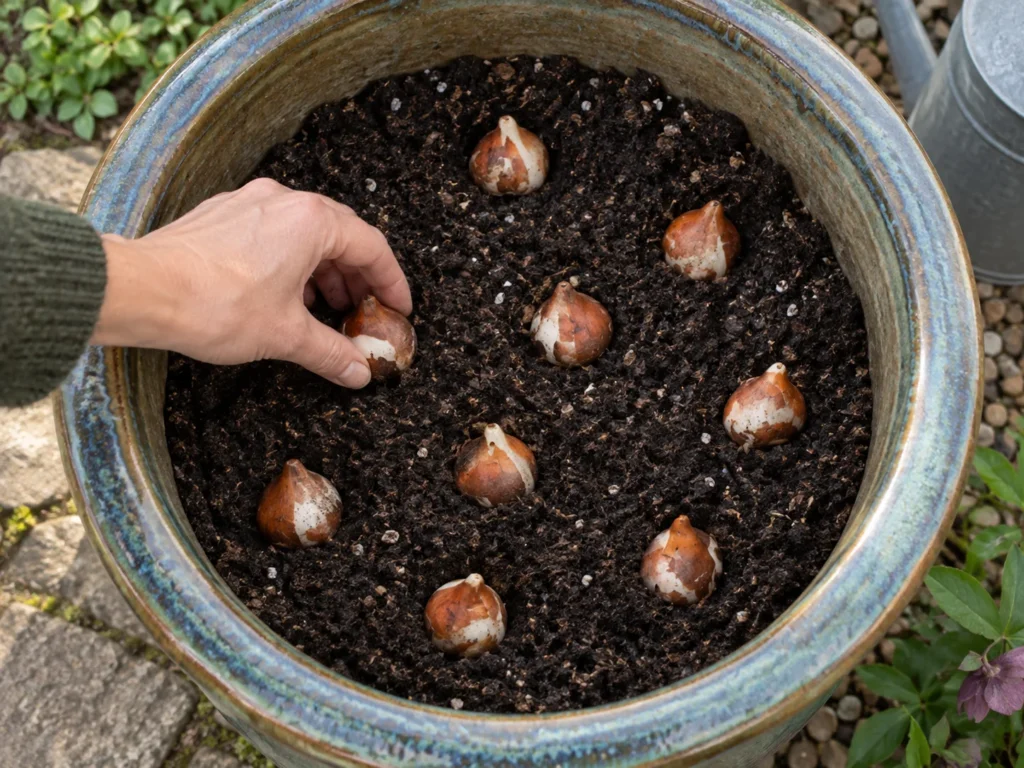
A large pot with one kind of tulip in it gives you two or three good weeks. After that it stands by the door looking like a bucket of soil, with three bent stems flopped over the rim, until you finally get around to pulling them out in June.
That is not bad luck and it is not your watering. That is what a single layer of a single variety does.
A bulb lasagna is the fix. You stack bulbs at three different depths inside one container, so the deep layer comes up last and the shallow layer comes up first. The same pot then carries colour from late winter through to the middle of May, and you only planted it once.
What is a bulb lasagna?
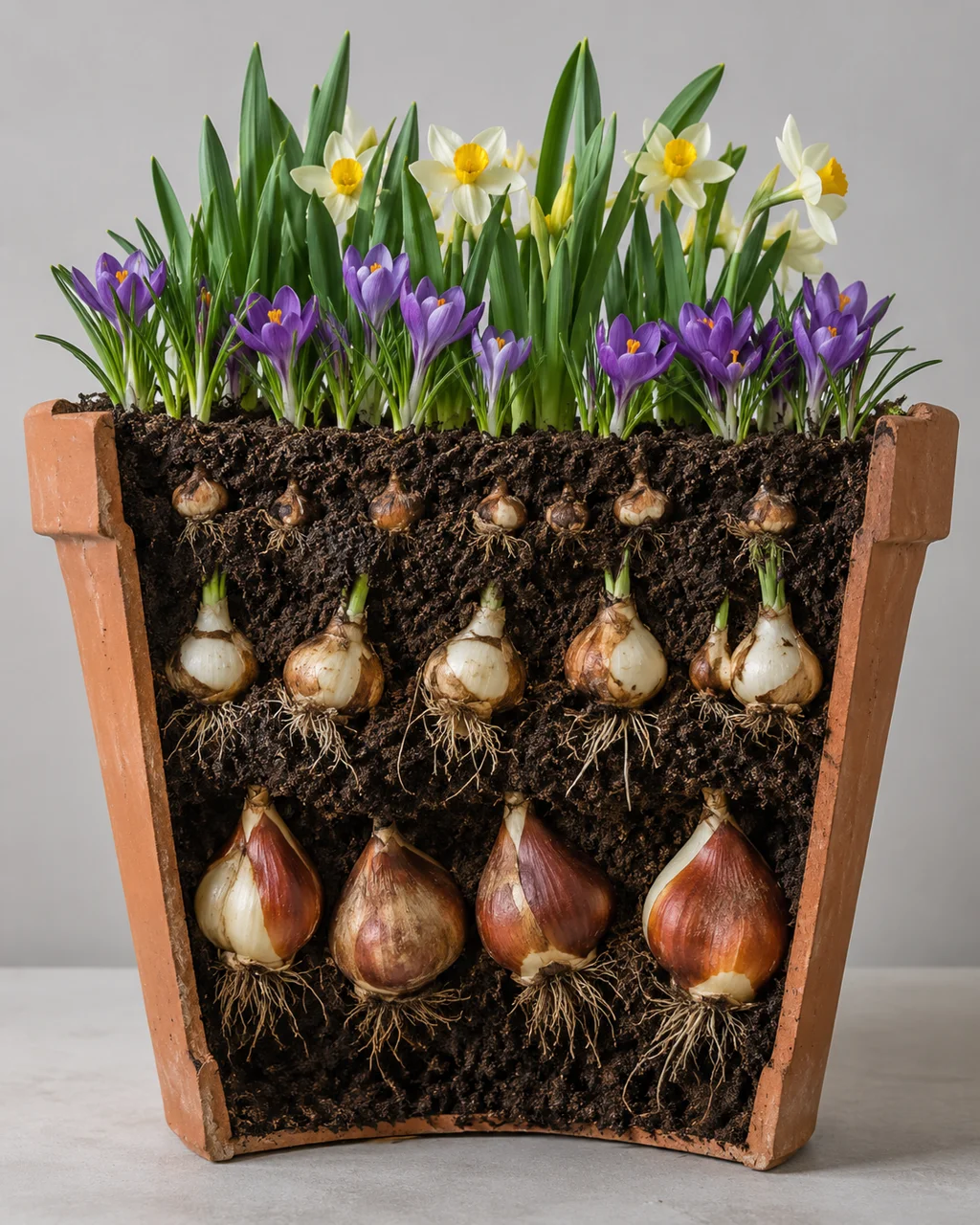
A bulb lasagna is one container planted with three layers of bulbs at three depths, separated by soil. Big late bulbs such as tulips go deepest, mid season narcissus sit in the middle, and small early bulbs such as crocus go near the surface. Each layer flowers in turn.
The name bulb lasagna comes from the way the pot is built, not from anything fancy in the planting. If you can dig a hole and cover it over, you can do this, and it takes about twenty minutes on an October afternoon.
The three layers, from the bottom up
Build a bulb lasagna in a pot that is at least 12 inches, or 30 cm, deep. Anything shallower and the bottom layer ends up too close to the surface to be worth separating.
Bottom layer: the big late bulbs
Large tulips and full sized narcissus go at the bottom of a bulb lasagna, roughly 8 inches or 20 cm below the finished soil surface. These are the last to flower, usually late April into May in a coastal garden, later inland.
Set them pointed end up, leave a small gap so none of them touch, then cover with about 2 inches or 5 cm of soil over their noses.
Middle layer: the mid season bulbs
Dwarf narcissus like Tete a Tete, mid size tulips, or a handful of Anemone blanda go in next, around 5 inches or 13 cm from the surface. This is the layer of a bulb lasagna that fills the gap between the early flush and the late one.
Here is the detail that matters. Place these bulbs in the gaps between the ones below, not directly over their noses. A shoot will bend around an obstacle, but it does not need to if you offset the layers by an inch or two.
Top layer: the small early bulbs
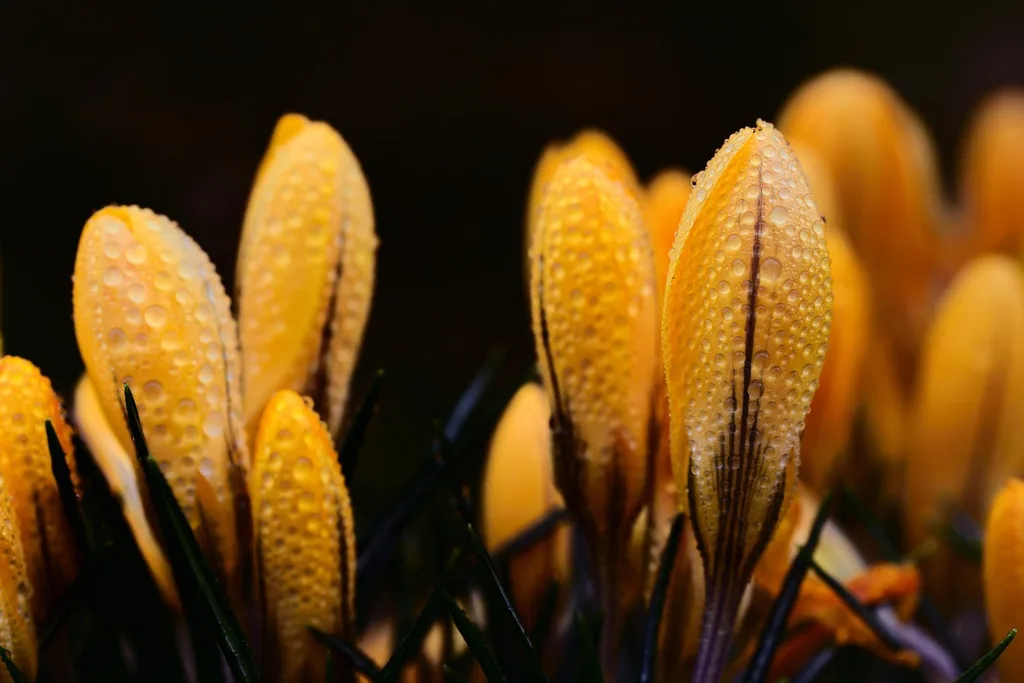
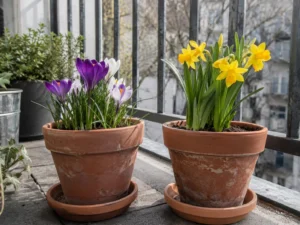
Crocus, muscari, snowdrops and Iris reticulata go last, about 3 inches or 7 cm deep. These are the ones that open in February while the rest of the street is still brown, and they are the reason the pot earns its space through the worst part of the year.
Because the top bulbs are small, you can pack a lot of them into a bulb lasagna. Cover with soil, firm it gently, and leave a finger width between the surface and the rim so water does not run straight off.
Do the deep bulbs push through the ones above them?
They come up around them. A tulip shoot from the bottom layer meets the bulb above it and bends past, which costs the plant nothing you will ever notice. Offsetting each layer so the bulbs sit in the gaps below removes even that, and it takes a few extra seconds per layer.
What kind of pot works, and what does not
For a bulb lasagna, depth matters more than width. A tall narrow pot will do a decent lasagna, and a wide shallow bowl will not, because there is nowhere to put the bottom layer.
The pot needs a drainage hole that is actually open. Check it with your finger before you fill anything. A blocked hole is invisible once the soil is in, and it is the most common way a winter pot is lost.
Wall thickness makes a real difference outside. A thick walled ceramic pot buffers the swing between a frosty night and a mild afternoon far better than thin plastic, and that swing is harder on bulbs than steady cold. The handmade Vietnamese ceramic pots we bring into the shop are heavy for their size for exactly that reason, and we keep a few in the store planted up so you can see the proportions before you commit.
The soil, and the mistake that ruins the whole pot
Fill a bulb lasagna with free draining potting mix, not garden soil. Garden soil packs down solid in a container over a wet winter, and bulbs sitting in airless mud go soft long before spring arrives. If you like mixing your own, our potting mix recipe with coco coir, compost and perlite drains well enough for bulbs without drying out in July.
Bulbs come with their first spring already packed inside them, so they are not hungry at planting time. A handful of balanced granular feed worked into the middle of the pot is plenty.
Skip the gravel layer at the bottom. It does not add drainage, it just lifts the wet zone closer to your bulbs.
Building it, step by step
- Check the drainage hole is clear and stand the pot where it will live, because it gets heavy.
- Fill with potting mix to about 9 inches or 23 cm below the rim.
- Set the largest bulbs, pointed end up, not touching each other or the pot wall.
- Cover with 2 inches or 5 cm of mix.
- Set the middle layer in the gaps, cover again.
- Set the small early bulbs near the top, cover with about 3 inches or 7 cm.
- Water once, thoroughly, then leave it to the rain.
If you want a stack that is already worked out, the four packs we layer in our own pots are chosen so the flowering times run into each other instead of overlapping, which is the fiddly part to get right on your own the first time.
Where the pot should stand from November to February
Outside, where winter weather reaches it. Bulbs need weeks of cold soil before they will flower, and a pot tucked under a covered porch is the one place a bulb lasagna reliably disappoints, because it stays too warm and too dry.
Raise the pot on feet or a couple of bricks so water leaves the base freely. In a hard cold snap, push your pots together against a house wall, which is the same principle we use when getting raised beds through a Vancouver winter. If you garden in a colder zone, the pot itself is the thing to think about, and we go through that in detail in do bulbs in pots survive winter outside in Canada.
What people get wrong
Overwatering is the main way a bulb lasagna is lost. Between November and February the rain does the job in most of the country, and a pot kept wet through a mild winter loses bulbs to rot, not to frost.
The second is crowding a bulb lasagna so tightly that bulbs touch. One soft bulb passes it on to whatever it is pressed against. Leave the gap.
If you would rather watch than read, Darrell covers planting depths for spring bulbs, shown in the pot in a short video on our channel.
What a bulb lasagna saves you, and what it asks of you
One pot, one variety, one flush. That is what most people buy, and it gives you three weeks in April followed by two months of a container full of soil by the door. You paid for the pot, the mix, the bulbs and the afternoon, and you got a fortnight.
The reason people skip a bulb lasagna is not difficulty. It is that the advice online is written for milder places, and the flowering times on packets rarely say whether they mean a coastal spring or a prairie one. So you stand there with four packets, unsure whether they follow each other or all open at once.
A pot by the door is a public thing too. It is the first thing anybody sees when they visit, and February is when a garden here most needs something to look at. A container doing nothing all winter is a small daily disappointment.
What we can do is take the timing guesswork off you. The packs we layer are chosen so the waves run into one another rather than overlapping, which is the fiddly part to judge from a packet. Every bulb is checked at the neck and base before it is packed, because one soft bulb in a wet January takes the ones it is touching with it. Reserving ahead of the shelf holds better terms than waiting. Darrell has more than 25 years of hands on gardening and landscaping behind him and plants these pots himself.
Build a bulb lasagna in October and on the coast the last week of February can have crocus open by your door while the rest of the street is brown, with the colder zones a few weeks behind, then muscari, then narcissus, then tulips. Plant one flat layer instead and you may be looking at a bucket of soil for most of the spring.
Frequently asked questions
How many weeks of flowering does a bulb lasagna give you?
In a coastal British Columbia garden, a well built pot usually runs from mid February to early May, so somewhere around ten to twelve weeks with short gaps between waves. Colder zones start later and compress the season, often March into May.
Can I plant a layered bulb pot in November or December?
You can, as long as the soil in the pot is still workable and not frozen solid. Late planting usually means later flowering rather than no flowering. What you cannot do is plant in spring, because the bulbs need those weeks of cold behind them, and a dry bulb bought in April has already missed the window.
Do I need to lift the bulbs after they flower?
Not right away. Let the leaves die back on their own, because that is how the bulb refills itself for next year. Crocus, muscari and narcissus often come back well in the same pot for several years. Large tulips are the least reliable repeaters in containers, so many gardeners treat that bottom layer as a replaceable layer.
How many bulbs should go in each layer?
It depends on the diameter of the pot rather than the variety, and packing a container is different from spacing a bed. We wrote the numbers out by pot size in how many bulbs can you fit in one pot, including the point where a pot goes from full to too full.
Ordering for this autumn
Picture the last week of February. The garden is still brown, and there is a pot by your door with crocus open on it, then muscari behind that, then narcissus, then tulips in April. That is one afternoon of work in October, done once.
Our bulbs arrive in small lots, and once a variety is spoken for we cannot reorder it partway through the season. The other deadline is not ours at all. Bulbs need to be in soil before the ground goes cold, which in most of Canada means October into early November.
Booking ahead does hold better conditions than waiting until the packs land on the shelf, and it means the varieties you actually want are set aside under your name. If you would like to see what goes into ours, here are the bulbs we picked for the layered pot.
Darrell has been planting on this coast for more than twenty five years, and he opens the boxes himself before anything goes out.
Visit us
DH Garden Centre
3742 West 10th Avenue, Vancouver, BC V6R 2G4
Open daily, 11:00 to 18:30
604-929-7335
If you are anywhere near Kitsilano, bring the pot you want to plant, or a photo of it with something for scale. It is easier to work out the layers with the pot in front of us than over the phone.
Keep reading
Have a plant question? Bring it to the counter.
DH Garden Centre is at 3742 West 10th Avenue in Kitsilano, Vancouver, open 11:00 to 6:30 every day. Bring the plant, or a photo of the spot you want to fill, and we will look at it with you. If you buy a pot here we repot the plant at the counter, soil included up to 5 litres.
