
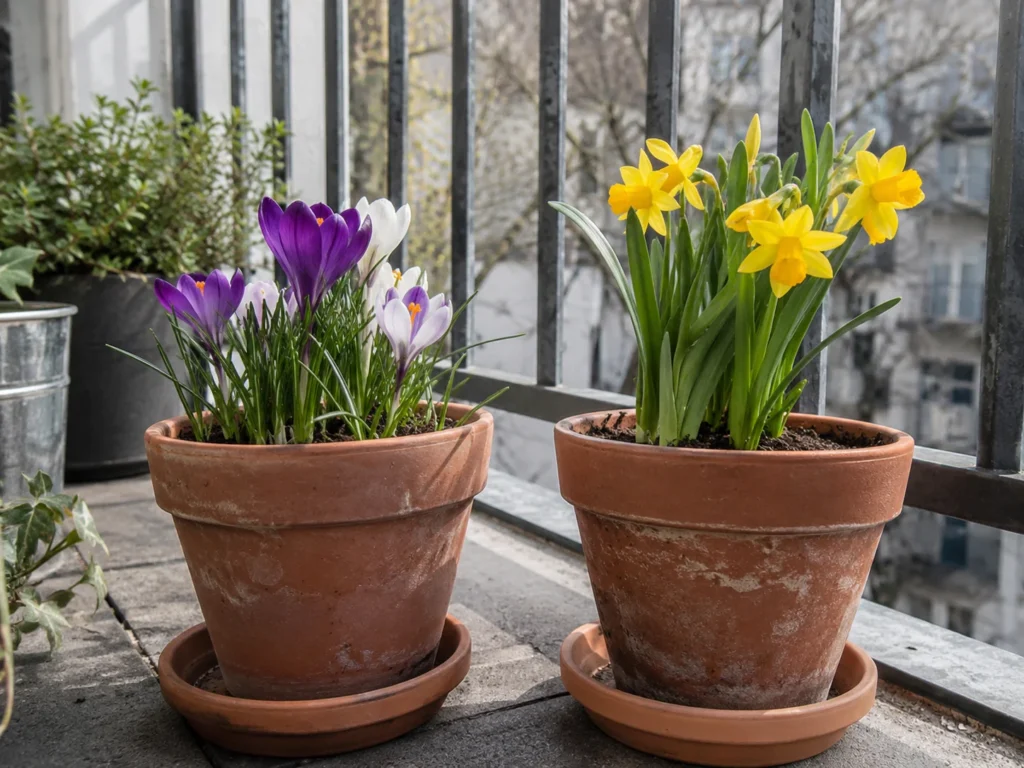
In February you are standing at the glass door with a mug in your hand, looking at two empty containers you meant to fill in the autumn and did not.
The fix is a twenty minute job in October, and it costs you nothing all winter. The catch is that half the bulbs on the shelf are wrong as spring bulbs for balconies, and the reason has nothing to do with hardiness.
What makes a bulb suitable for a balcony?
With spring bulbs for balconies, the short answer is height. Spring bulbs for balconies need to be low growing and stiff stemmed, because a balcony is windier than any garden bed at ground level. Short varieties such as crocus, muscari, dwarf narcissus and dwarf tulips hold their shape. Tall tulips lie flat.
Height is the part nobody warns you about
A tall Darwin hybrid tulip stands 20 to 24 inches, or 50 to 60 cm, which rules it out of any list of spring bulbs for balconies. On a tenth floor balcony, or a rooftop, or an exposed corner three streets from the water, that stem catches the wind like a sail. It goes over in the first spring storm and spends April lying across the floor with the flower face down.
Nothing is wrong with the bulb, and it was never meant to be one of the spring bulbs for balconies. It was bred for a sheltered border. The same pot planted with something 8 inches tall would have come through the same storm without you noticing there had been one.
Which spring bulbs for balconies actually hold up
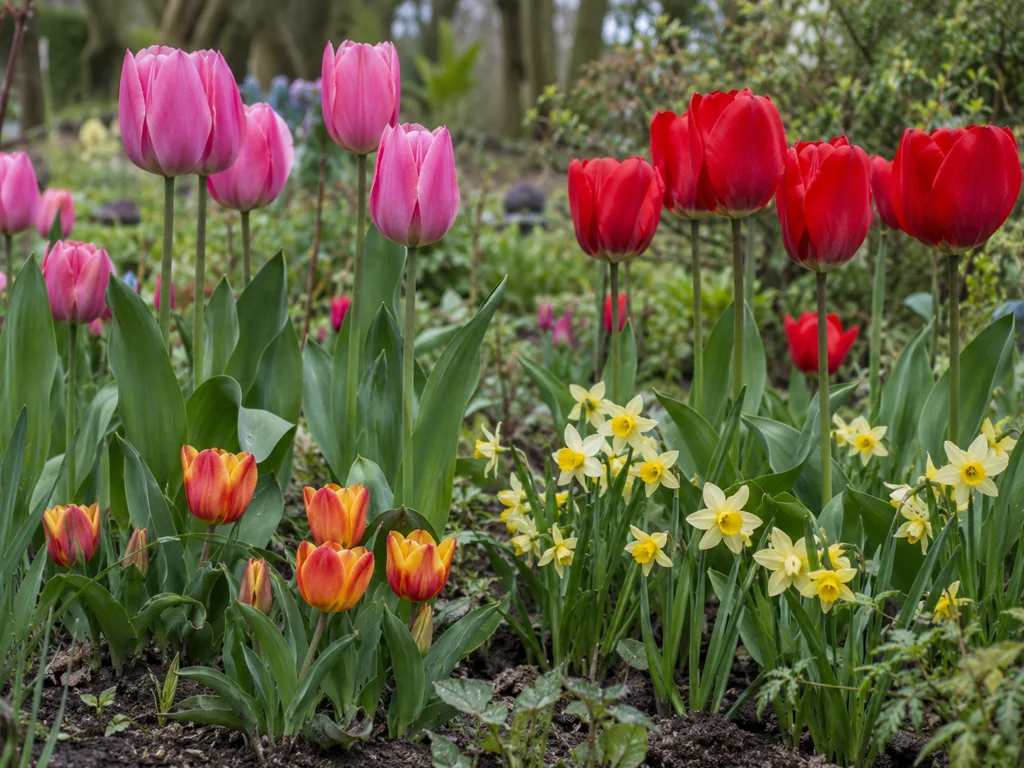
Here are the spring bulbs for balconies we plant in containers ourselves, roughly in the order they open. Heights are for average conditions, and a windy site tends to produce slightly shorter, sturdier growth.
Crocus, 3 to 4 inches or 8 to 10 cm
The first of the spring bulbs for balconies to open, often late February on the coast and March further inland. Low enough that wind is simply not a factor. Plant plenty, because each corm gives you only a few flowers and the effect comes from the mass.
Iris reticulata, 4 to 6 inches or 10 to 15 cm
Small, deep blue or purple, and out at roughly the same time as the crocus. It looks delicate and is not. This is one of the few bulbs that genuinely prefers a container, because it likes sharp drainage and hates sitting wet.
Snowdrops, 4 to 6 inches or 10 to 15 cm
Earliest of the lot in a mild winter. They are quiet flowers and they show up best against a dark pot near a doorway where you pass them daily.
Anemone blanda, 4 to 6 inches or 10 to 15 cm
Daisy shaped, opens flat in sun and closes at night, and spreads its flowering over several weeks in March and April. It fills the gap between the early crocus and the later narcissus better than almost anything else.
Muscari, 6 to 8 inches or 15 to 20 cm
Grape hyacinth. Tough, cheap to plant in numbers, and it comes back in the same pot for years. The foliage often appears in autumn and looks untidy through winter, which surprises people the first time. It is normal and it does no harm.
Dwarf narcissus, 6 to 10 inches or 15 to 25 cm
Tete a Tete is the standard for a reason, and Minnow is worth knowing if you want something a little taller with several flowers per stem. Both hold up in wind where a full sized daffodil at 16 inches will not.
Dwarf tulips, Greigii and Kaufmanniana groups, 6 to 12 inches or 15 to 30 cm
If you want a real tulip on a balcony, these are the two groups to look for. Kaufmanniana opens early and flat, like a water lily. Greigii is a little later with mottled foliage. Both sit low, and both come back more reliably in a pot than the tall hybrids do.
If you would rather not assemble the mix yourself, the short varieties we chose for containers are four packs picked to run from late winter into April, all of them under 10 inches.
Do balcony bulbs need a big pot?
Bigger than you think, and deeper more than wider, because spring bulbs for balconies need root room below them more than they need surface. A pot at least 10 inches or 25 cm across and the same deep gives the roots room and, more importantly, gives the soil enough mass to buffer temperature swings. Small pots freeze hard, thaw fast, and dry out in a windy March.
The honest part about small bulbs
Most spring bulbs for balconies are small bulbs, and small bulbs make small flowers. This is not the enormous tulip display from a magazine, and if that is the picture in your head, a balcony is going to disappoint you no matter what you plant.
What you get instead is a container that starts in late February and is still doing something in April, on a surface that gets more wind than any garden bed, and most of it comes back the following year. That trade is worth making, and it is better to know now than in March.
Soil, drainage and the feet under the pot
Use a free draining potting mix, not garden soil, which packs down solid over a wet winter and turns airless. If you like to mix your own, our coco coir, compost and perlite recipe drains well and still holds enough moisture through a dry spring.
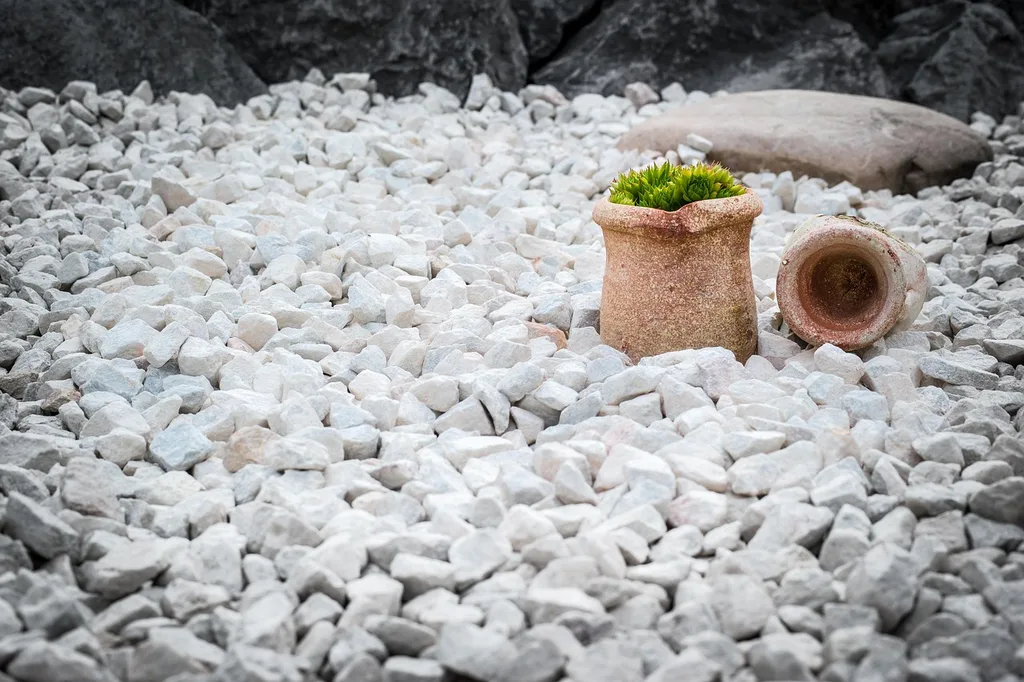
Then raise the pot, because standing water takes out more spring bulbs for balconies than cold ever does. A couple of pot feet, or two strips of wood, or even a pair of bricks under the rim will keep water moving out of the base instead of pooling under it. On a balcony this matters more than in a garden, because most balcony floors are flat concrete or tile and water simply sits there.
Wind, sun and where the pot should stand
Bulbs need weeks of cold soil before they will flower, so leave the pots outside where winter weather reaches them. A sheltered spot against the building wall is fine and helps in a cold snap. A fully covered balcony where rain never lands is the one situation that catches people out, because the soil dries out and you have to water through the winter yourself.
Most spring bulbs for balconies are happy in the light a balcony gets, including a north facing one, since they flower before the leaves are on the trees and before the summer sun angle arrives. Full sun makes for slightly stiffer stems and earlier flowering.
Stretching one pot across the whole spring
If your pot is at least 12 inches or 30 cm deep, plant in layers rather than all at one depth. Dwarf tulips deepest, dwarf narcissus in the middle, crocus and muscari near the top, and the pot runs from February into May instead of giving you one short burst. The full method is in our guide to layering bulbs in one pot.
If you would rather watch than read, Darrell covers how crowded a container of tulips should actually be in a short video on our channel.
What the right spring bulbs for balconies save you
A balcony is not a small garden, it is a windier one. Buy on the picture rather than the height and you spend money on tall tulips that go flat in the first March storm and lie there for the rest of April. The bulbs were fine, the pot was fine, and the whole thing is unusable anyway.
The harder part is not knowing who to believe. Container advice online is written for gardens with fences and hedges, so heights are quoted for sheltered borders. On a tenth floor, or three streets from the water, those numbers are simply wrong, and March is when you find out.
A balcony is also the bit of home you look at every single day, usually through glass with a mug in your hand. It is where you stand when you need two minutes to yourself, and it is the first thing a friend sees when they step outside. An empty container out there in February is a daily reminder of a job you skipped.
What we can do is choose spring bulbs for balconies on height first and colour second, which is the opposite of how bulbs are usually sold. Each bulb is checked at the neck and base before packing, because a small pot has no room to carry a soft one. Reserving ahead of the shelf holds better terms than waiting. Darrell has more than 25 years of hands on gardening and landscaping behind him and plants the shop containers himself.
Get your spring bulbs for balconies right and the end of February on the coast, or March further inland, has colour on the other side of the glass, low to the pot, holding steady in the wind that used to flatten everything. Choose on the photograph instead and you may be sweeping up stems in April.
Frequently asked questions
Can I leave balcony pots outside all winter in Canada?
In most of the country, yes, as long as the pot drains freely and is not standing in water. Pots run colder than the ground because cold reaches them from every side, so in colder zones the pot needs more thought. We go through the whole question, including what to do in zone 4 and zone 3, in do bulbs in pots survive winter outside in Canada.
Will spring bulbs come back on a balcony next year?
Crocus, muscari, Iris reticulata and dwarf narcissus usually repeat well in a container for several years if you let the leaves die back naturally instead of cutting them off. Dwarf tulips repeat better than tall hybrids, though they thin out over time. Refresh the top layer every couple of autumns and the pot keeps its density.
How much watering do balcony bulbs need over winter?
On an open balcony, rain generally does the job from November through February and you can leave them alone. The usual way to lose a bulb is looking after it too much, since one kept wet through a mild winter goes soft. Under a roof or a deep overhang, check monthly and give a small drink if the soil is dry.
Do I need to feed bulbs in a balcony pot?
Not at planting time. A bulb arrives with the food for its first spring already inside it. A handful of balanced granular feed worked into the mix does most of its work for the following year, and a light feed after flowering, while the leaves are still green, helps the bulb refill itself for next spring.
Ordering for this autumn
Picture the same glass door at the end of February, except this time there is colour on the other side of it, low to the pot, holding steady in the wind that used to flatten everything. Then muscari behind it in March, then dwarf narcissus in April.
Our bulbs come in small lots and we cannot reorder a variety once it is spoken for partway through the season. The other deadline is not ours. Bulbs have to be in soil before the ground goes cold, which in most of Canada means October into early November.
The spring bulbs for balconies we bring in are chosen on height first and colour second. Booking ahead holds better conditions than waiting until the packs are on the shelf, and it puts the varieties you want under your name. Here are the balcony and pot bulbs we set aside. Darrell has been planting containers on this coast for more than twenty five years, and he opens every box himself before it goes out.
Visit us
DH Garden Centre
3742 West 10th Avenue, Vancouver, BC V6R 2G4
Open daily, 11:00 to 18:30
604-929-7335
If you are in Kitsilano, come by with a photo of the balcony and which way it faces. That tells us more in ten seconds than a description does, and the handmade ceramic pots are on the floor by the door if you want to see how they sit.
Keep reading


Have a plant question? Bring it to the counter.
DH Garden Centre is at 3742 West 10th Avenue in Kitsilano, Vancouver, open 11:00 to 6:30 every day. Bring the plant, or a photo of the spot you want to fill, and we will look at it with you. If you buy a pot here we repot the plant at the counter, soil included up to 5 litres.
