
Most people get how many bulbs in one pot badly wrong on the low side, then wonder in April why the pot looks thin next to the photos that made them buy the bulbs.
The instructions on the pack tell you how to space a garden bed, not how many bulbs in one pot. In a pot you can go much closer than that, and you should.
How many bulbs in one pot is the right number?
Work out how many bulbs in one pot by diameter, not by variety. In a 12 inch or 30 cm pot you can fit roughly twelve to fifteen large tulips in a single layer, or around forty crocus. The one rule that does not bend is that no bulb should touch another bulb or the wall of the pot.
Numbers by pot size
These are single layer counts for how many bulbs in one pot, assuming a working drainage hole and fresh potting mix. Round down if your bulbs are unusually fat.
| Pot diameter | Large tulips or narcissus | Dwarf narcissus | Crocus, muscari, Iris reticulata |
|---|---|---|---|
| 6 in / 15 cm | 3 to 5 | 5 to 7 | 10 to 15 |
| 8 in / 20 cm | 5 to 7 | 8 to 12 | 15 to 25 |
| 10 in / 25 cm | 8 to 10 | 12 to 18 | 25 to 35 |
| 12 in / 30 cm | 12 to 15 | 18 to 25 | 35 to 45 |
| 14 to 16 in / 35 to 40 cm | 18 to 25 | 28 to 40 | 50 to 70 |
If those numbers for how many bulbs in one pot feel high, that is normal. A pot planted at bed spacing gives you a handful of stems standing apart from each other, which reads as a mistake even when every bulb has flowered perfectly.
Why can you plant bulbs closer in a pot than in the ground?
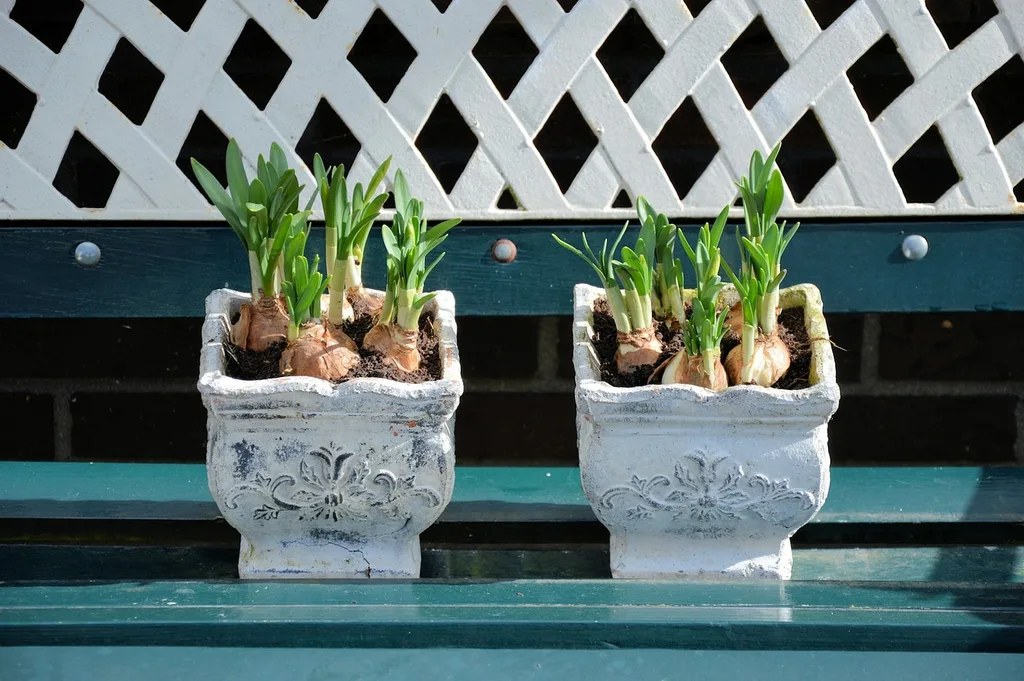
Because how many bulbs in one pot is a question about one spring, not about ten. In a border you leave room for the clump to widen and divide over years. A container is a display you will refresh, so the bulbs only need enough space to open and grow leaves, and that is a much smaller ask.
The spacing rule that matters more than the count
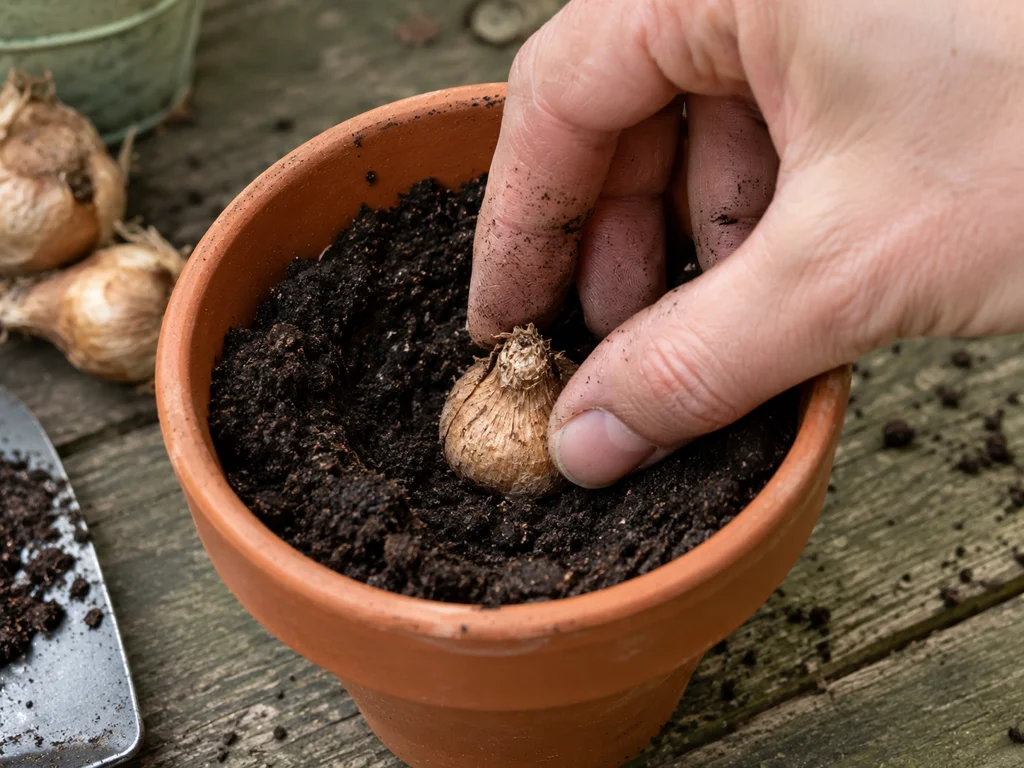
Whatever you settle on for how many bulbs in one pot, leave a finger width between them, roughly half an inch to an inch, or 1 to 2 cm. Leave the same gap between the outer ring and the pot wall.
That gap, more than the diameter of the pot, is the real limit on how many bulbs in one pot you can plant. There are two reasons, and neither is about crowding the flowers. First, bulbs pressed against each other pass on rot. One soft bulb in a wet January will take the one it is touching with it, and it will not touch anything if you left the gap. Second, the wall of the pot is the coldest and wettest part of the whole container, so bulbs jammed against it get the worst of both.
Layering changes the arithmetic
The counts above answer how many bulbs in one pot when you are planting a single layer. If your pot is at least 12 inches or 30 cm deep, you can stack two or three layers at different depths and multiply the total by roughly two to three.
That is the technique known as lasagna planting, and it is the reason a single pot can flower from February through to May instead of giving you one short burst. We walk through the depths layer by layer in our guide to building a bulb lasagna, including why the upper bulbs should sit in the gaps rather than straight on top of the ones below.
For a layered pot, the four packs we use in our own containers are sized so one set fills a large pot without leftovers rattling around in the shed until they dry out.
Depth, and the soil underneath them
How many bulbs in one pot is only half of it. A general rule is to plant a bulb about three times its own height deep, so a big tulip sits around 6 to 8 inches or 15 to 20 cm down, and a crocus around 3 inches or 7 cm.
Which means the pot has to be deeper than the deepest bulb by a good margin, with soil under it rather than a bulb sitting on the drainage hole. Use a free draining potting mix instead of garden soil, because garden soil in a container packs down over a wet winter and turns airless. If you mix your own, this coco coir and perlite blend holds together without going to mud.
Skip the gravel layer at the bottom. It does not add drainage, it just lifts the wet zone closer to your bulbs.
Signs the pot is genuinely overloaded
There is a point where how many bulbs in one pot stops being generous and starts being a problem. A crowded pot looks full. An overloaded one shows up in three ways.
Bulbs sit shoulder to shoulder with no soil between them, so there is nothing holding moisture evenly and nothing separating a soft one from a healthy one. The soil surface bulges or cracks as growth pushes up, which usually means the top layer went in too shallow because there was no room left. And the pot dries out unevenly in March, with one side wilting while the other is still damp, because there is more bulb than soil in there.
If you find yourself pressing bulbs in at an angle to make them fit, take three out. The pot will look better for it.
A note on pot material
Thin plastic swings hard between a frosty night and a mild afternoon, and that swing is harder on bulbs than steady cold. A thick walled ceramic pot holds a steadier temperature and a steadier moisture level, which is why we bring in handmade Vietnamese ceramic pots for the shop and why we plant our own display pots in them.
Whatever the material, the drainage hole has to be clear before you fill it. Check with a finger. It is invisible once the soil is in, and a blocked hole is the most common way a winter pot is lost.
If you would rather watch than read, Darrell covers Darrell putting crocuses in a pot without crowding them in a short video on our channel.
Why how many bulbs in one pot decides your whole spring
Under planting a container is the quiet way to waste a season. You buy the pot, the mix and the bulbs, give it an afternoon, and in April you get eight stems standing apart in a lot of visible soil. Nothing failed. It just looks like a mistake, and the only fix is to buy more and wait a year.
Over planting costs you differently. Bulbs pressed against each other pass rot along in a wet January, so one soft one takes two more with it, and you find out in March. Both errors come from the same place, which is a packet number written for a garden bed.
The mental part is the search. Look up how many bulbs in one pot and you get answers ranging from four to forty for the same container, most with no pot size attached at all. So you split the difference and spend the winter unsure.
What we can do is make the counting easy and the stock sound. The layered set is sized so one lot fills a large pot without odd packets left rattling in the shed. Every bulb is felt at the neck and base before it is packed, because in a packed pot one soft bulb is not a private problem. Darrell has more than 25 years of hands on gardening and landscaping behind him, and he will count a pot out with you at the counter.
Get how many bulbs in one pot right and April usually gives you a container where the flowers meet each other and you cannot see soil between them. Guess at it and you either look at a thin pot for a month or lose part of it to rot.
Frequently asked questions
Can bulbs touch each other in a pot?
Try not to let them. A gap of half an inch to an inch, or 1 to 2 cm, is enough. Touching bulbs pass rot between them over a wet Canadian winter, and one soft bulb becomes three. The same applies to the pot wall, which stays colder and wetter than the middle of the soil.
How many tulip bulbs fit in a 12 inch pot?
Around twelve to fifteen large tulips in a single layer, with a finger width between them and a gap around the edge. If the pot is also at least 12 inches or 30 cm deep, you can put narcissus above them and crocus above that, which takes the same pot from a two week show to a season that runs from February into May.
Do I need more bulbs for a wide shallow bowl?
A wide bowl holds plenty of small bulbs and very few large ones, because large tulips and narcissus need depth. Plant crocus, muscari, Iris reticulata and dwarf narcissus in shallow containers, and save the deep pots for the tall late varieties. Trying to squeeze a big tulip into a shallow bowl usually ends in a short, floppy stem.
Will a packed pot still survive winter outdoors?
Yes, provided the pot drains and the bulbs are not touching. The thing that kills bulbs in containers over winter is standing water rather than low temperature, and a dense planting only becomes a problem when there is no soil between the bulbs. We go through the whole winter question in do bulbs in pots survive winter outside in Canada.
Ordering for this autumn
The pot you want in April is the one you cannot quite believe you planted, where the flowers meet each other and you cannot see soil between them. That comes from how many bulbs in one pot you were willing to plant back in October.
Our bulbs arrive in small lots and we cannot reorder a variety once it is spoken for partway through the season. The harder deadline belongs to the weather, since bulbs need to go into soil before the ground turns cold, which across most of Canada means October into early November.
Booking ahead holds better conditions than waiting for the packs to reach the shelf, and it means the counts you planned for are actually set aside. Here is the layered set we put together for large pots, and if you are planting on a balcony instead, these are the short varieties that hold up in wind.
Visit us
DH Garden Centre
3742 West 10th Avenue, Vancouver, BC V6R 2G4
Open daily, 11:00 to 18:30
604-929-7335
If you are in Kitsilano, bring the pot in or send a photo with a hand next to it for scale. Darrell will count it out with you at the counter, which takes about two minutes and saves guessing.
Keep reading

Have a plant question? Bring it to the counter.
DH Garden Centre is at 3742 West 10th Avenue in Kitsilano, Vancouver, open 11:00 to 6:30 every day. Bring the plant, or a photo of the spot you want to fill, and we will look at it with you. If you buy a pot here we repot the plant at the counter, soil included up to 5 litres.
