

By the middle of April a lot of spring gardens have one very good week. Everything opens together, you take a photograph, and ten days later the whole thing is over and you are back to buying flowers at the till on a Friday.
A cut flower bulb garden is planted to do the opposite of that.
Short answer: a cut flower bulb garden is a patch planted with varieties that open one after another instead of all in the same week, so there is something worth cutting every few days for roughly two months. You choose by bloom time first and colour second, you put it somewhere the gaps do not bother you, and you cut in the early morning while the stems are still full of water.
What makes a cut flower bulb garden different from a display bed?
A display bed is planted so everything peaks together and looks full from the kitchen window, which is a different job from the one a cut flower bulb garden does. A cutting patch is planted so something new opens every week, and it goes where the holes you leave behind do not matter. Same bulbs, different job, different spot in the garden.
That difference decides everything else. In a display bed you buy quantity of one variety. In a cut flower bulb garden you buy smaller groups of several varieties, spread across the season, and you accept that the bed will look picked over.
Build it in three waves
Think of the spring as three waves rather than one date. Buy something for each wave and the cut flower bulb garden keeps producing. Buy everything from one wave and you get the one good week again.
The exact calendar shifts with where you garden. On the coast here in Vancouver the first wave in a cut flower bulb garden usually starts in March. In colder parts the same sequence happens later and faster, sometimes inside five or six weeks. The order does not change.
Wave one, the early cutters
Early narcissus do the heavy lifting here, particularly the trumpet types and the small cyclamineus types with the swept-back petals. Add muscari for short stems in small jars, and single early tulips if you want tulip shape before anyone else has it. Fritillaria meleagris, the checkered snake’s head, is worth a small group for the same window.
These are the flowers that arrive when you have nothing else, and in a cut flower bulb garden that is most of their value.
Wave two, the middle of the season
This is where the bulk of the cutting in a cut flower bulb garden happens. Triumph tulips are the workhorses, with strong straight stems around 40 to 50 cm. Large cupped narcissus overlap with them. Leucojum aestivum, the summer snowflake, throws up tall stems of little white bells and holds well once it is in water.
Wave three, the late finish
Single Late and Darwin Hybrid tulips carry you into May, and Darwin Hybrids have the extra advantage of coming back more reliably than most modern tulips. Narcissus poeticus, the pheasant’s eye, is the last daffodil to open and the one that actually smells like something. Then alliums and camassia take over as the tulips finish.
Where should you plant a cut flower bulb garden?
Put it somewhere you do not look at every day. A row along a fence, the strip down the side of the house, the end of the vegetable bed, the back of a border. Cutting leaves gaps, and gaps are fine in a working row and annoying in the bed by the front door.
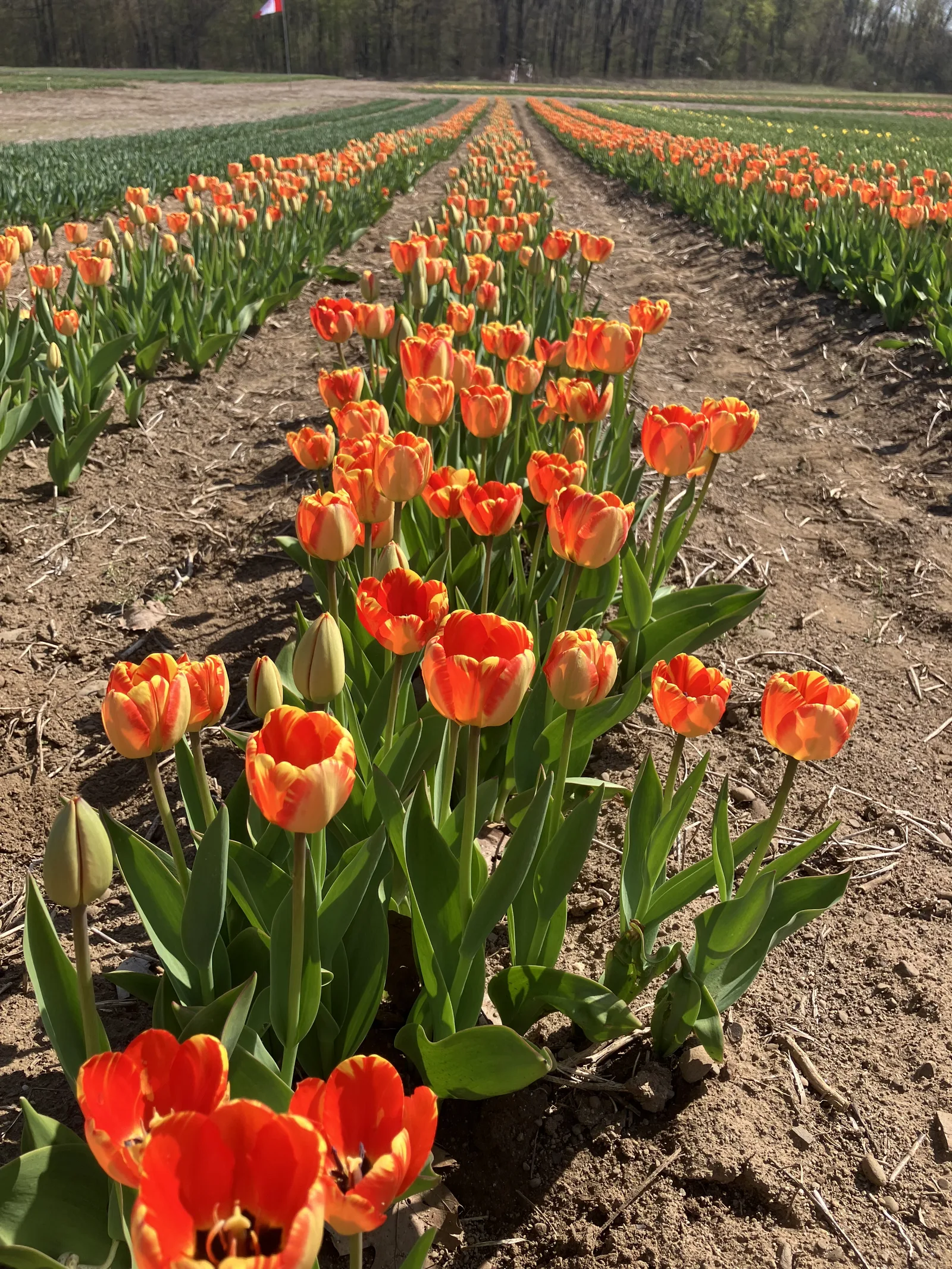
The soil matters more than the view. Bulbs sitting in ground that stays soggy through a coastal winter rot quietly and you never see it happen, you just get an empty April. If your patch is heavy clay, work on the drainage in that clay soil before you plant, or build the row up a few inches with compost and grit.
If you have no ground at all, the same three wave logic works in pots on a balcony or a raised bed. You just need more bulbs per square foot and a plan for keeping the pots out of standing water.
How do you cut bulb flowers so they last in the vase?
Go out to the cut flower bulb garden in the early morning, before the sun has pulled water out of the stems. Take tulips when the bud has just coloured up and is still closed, and daffodils at the gooseneck stage, when the bud has bent over but not opened. Carry a bucket of water out and put the stems straight in.
Cutting at bud stage feels too early the first time. It is not. A tulip cut in tight coloured bud opens in the house over two or three days and then holds, while one cut wide open is already halfway through its life before it reaches the table.
One more thing about narcissus, and it catches almost everybody. The cut stems leak a sap that shortens the life of other flowers sharing the water. Stand them on their own for several hours first, then move them across without recutting the stems. There is more on that, and on which stems hold longest, in our guide to spring bulbs in a vase.
Take the flower, leave the leaves
This decides whether you have a cutting patch next year or a one season patch.
The leaves are what feed the bulb for the following spring, and they decide whether a cut flower bulb garden carries on or quietly runs down. Cut the stem above the foliage and leave every leaf you can on the plant. Cut the whole thing off at ground level, which is what most people instinctively do, and you get one strong season followed by a thinner one.
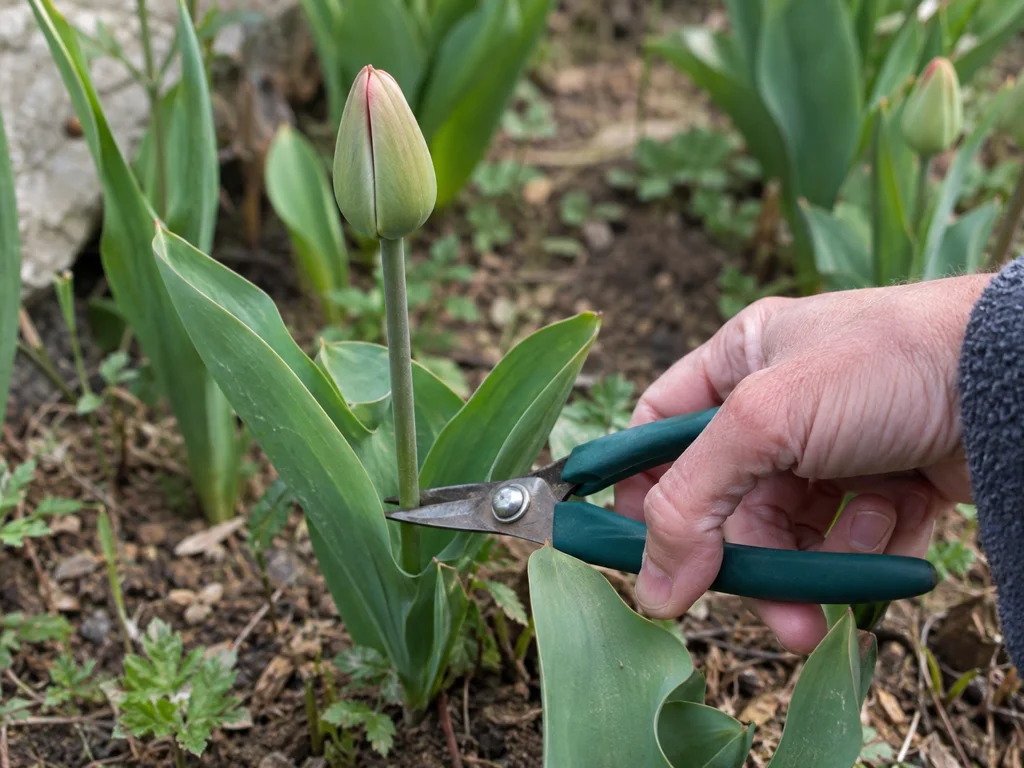
Deadhead anything you did not cut, so the plant is not spending the rest of spring building seed. Then leave the foliage alone until it yellows off on its own, usually around six weeks after flowering. It looks untidy, which is another reason the cutting patch belongs somewhere out of the way.
A row you can actually plant this October
Here is the cut flower bulb garden layout we use, and it fits a strip about a metre wide and three or four metres long.
- Plant in groups of seven to ten of each variety, not in single lines. A group gives you enough stems to cut a real handful without stripping the row bare.
- Tulips go about 15 cm (6 in) deep and 10 to 12 cm apart. Deeper is better on light soil and helps them last.
- Narcissus go a little deeper, 15 to 20 cm (6 to 8 in), and want a bit more room.
- Leucojum and muscari go 8 to 12 cm (3 to 5 in) deep.
- Put the tall late tulips and alliums at the back, the early narcissus in the middle, the short things at the front where you can reach them.
- Write down what went where. In March you will not remember.
Choosing the varieties is the fiddly part, because bloom sequence is not printed on most packets. If you would rather skip that homework, the five varieties we picked to open one after another are three tulips, a narcissus and a leucojum, chosen for that spread rather than for one photograph. Darrell picks them by stem length and bloom window, which is a different set of criteria from the ones a catalogue photo is chosen on.
Timing wise, these go in when the soil has cooled and stays cool, which on the coast is October into November and further inland is often late September. Our zone by zone tulip planting guide has the dates.
Then it is April and you cut an armful before dinner
That is the whole point of the exercise. You walk out with snips, you come back in with enough for the kitchen table and a jar for someone else, and the house smells like a garden for a week. Do it again the following weekend, because something else has opened.
Our bulbs arrive in small lots and we cannot reorder partway through the season, so what comes in is what there is. Reserving now puts your packs aside on better terms than waiting until they are on the shelf, and the real deadline is not ours anyway, it is the ground going cold. If you want to see what we put in the cut flower collection, it is all listed with bloom times.
If you would rather watch than read, Darrell covers tulips and spring irises coming through together in a short video on our channel.
What a cut flower bulb garden is really worth
Start with the money, it is easy to miss. A bunch bought on a Friday, then another the following Friday, all spring. Against that, a cut flower bulb garden is one October afternoon and a row of bulbs. The waste happens when you buy a hundred of one variety, get your one glorious week, then buy again next autumn to fix a problem that was not about quantity.
The tiring part is the choosing. Bloom sequence is not printed on most packets, catalogue photographs are taken at peak, and searching for an order of flowering gets you ten answers that disagree about the same tulip. People give up and buy by colour, which is exactly how everything opens in one week.
There is also the reason most people do this at all. A cut flower bulb garden turns into jars you hand to other people. One for the kitchen table, one for a neighbour who watched you plant it, one that goes to work with somebody on a Monday. Spring bulbs are worth more given away than photographed.
What we can help with is the part that is hard to look up. Darrell picks varieties by stem length and bloom window rather than by how they photograph, out of more than 25 years of hands on gardening and landscaping, and every pack is looked at by hand. Putting your name on packs early comes on better terms than the fall shelf, and there is somebody in Kitsilano to ask if you are unsure.
Plan the three waves and you cut something every few days for about two months. Plant on a guess and you get one very good week, then a bare row and a whole year to wait.
Frequently asked questions
How long will a cut flower bulb garden produce for?
In a coastal garden, expect roughly eight to ten weeks of cutting if you have bulbs from all three waves, usually March into early May. Colder zones get a shorter and later run, often five to seven weeks, because spring arrives fast and everything catches up with itself. Adding alliums at the end stretches it further into June.
Will the bulbs come back if I keep cutting them?
Narcissus, leucojum, muscari and alliums come back for years and slowly increase, as long as you leave the foliage on after cutting. Most modern hybrid tulips fade after the first two or three springs whatever you do, so plan on topping those up. Darwin Hybrid and species tulips last considerably longer than the rest.
Can I grow a cutting patch in containers instead?
Yes, and it works well on a balcony. Use deep pots, at least 30 cm, plant more densely than you would in the ground, and treat each pot as one wave rather than mixing everything. The one limit is volume. A pot gives you a jar of flowers at a time, not an armful.
Do I need special flower food for spring bulbs?
Not really. Clean water, a clean vase, stems recut on a slant, and no leaves sitting below the waterline will do most of the work. Tulips prefer cold water and a shallow fill. Change the water every couple of days and keep the vase away from the fruit bowl, since ripening fruit gives off ethylene and ages the flowers faster.
Come and see us in Kitsilano
If you would rather hold the bulbs and ask which ones open when, come in and we will walk you through the trays. Darrell has been gardening on this coast for more than twenty five years and he has opinions about stem length.
DH Garden Centre
3742 West 10th Avenue, Vancouver, BC V6R 2G4
Open daily, 11:00 to 18:30
604-929-7335
Keep reading

Have a plant question? Bring it to the counter.
DH Garden Centre is at 3742 West 10th Avenue in Kitsilano, Vancouver, open 11:00 to 6:30 every day. Bring the plant, or a photo of the spot you want to fill, and we will look at it with you. If you buy a pot here we repot the plant at the counter, soil included up to 5 litres.
